The Hidden Barriers for Women in Finance
21 October, 2026


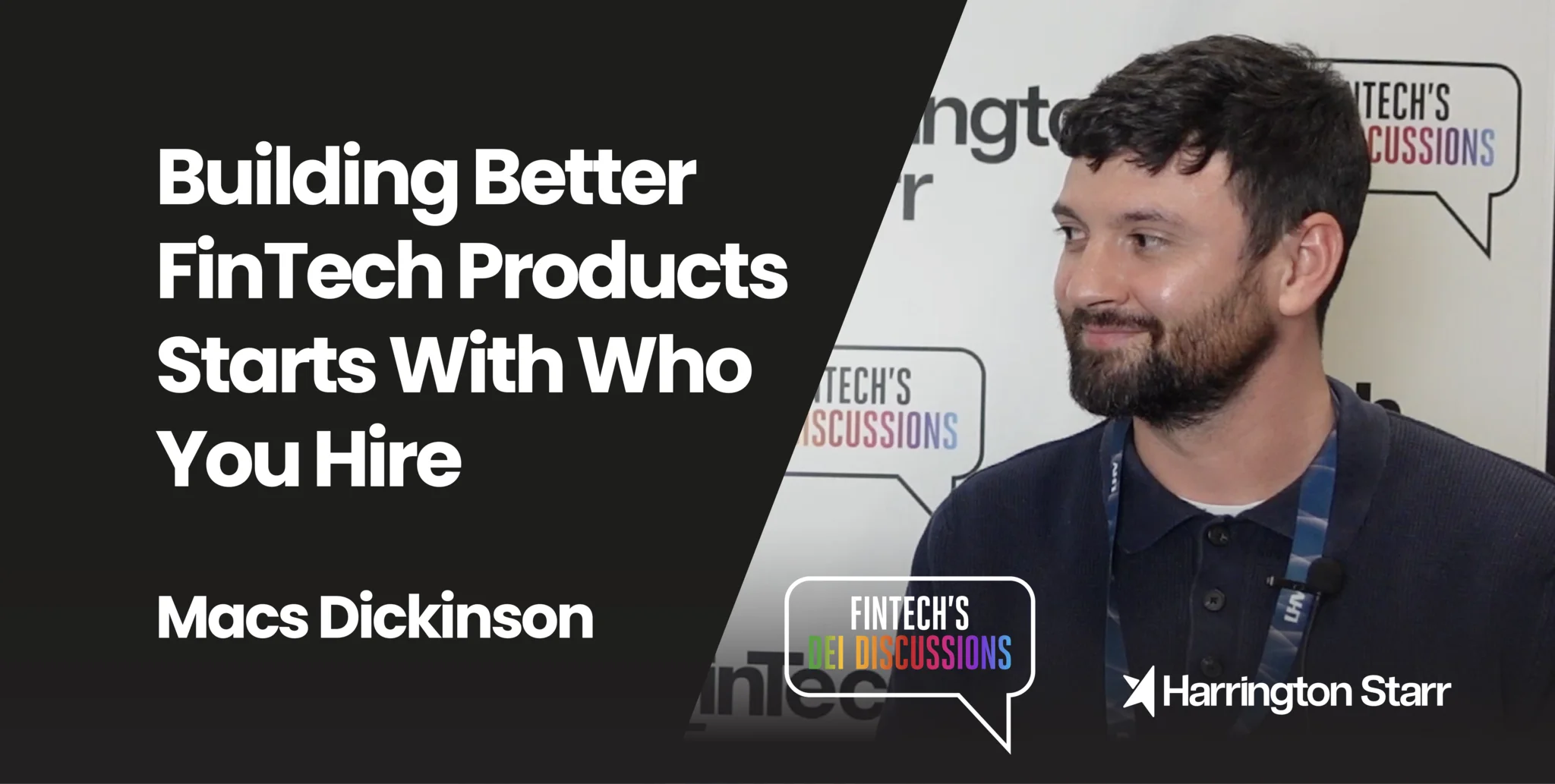
In this episode of FinTech’s DEI Discussions, recorded live at Pay360 2026, host Nadia Edwards-Dashti sits down with Macs Dickinson, Director of Engineering at LHV Bank, to explore one of the most important yet persistently misunderstood topics in financial technology: how talent, inclusion, and hiring practices directly shape the products we build. For a global FinTech recruitment business like Harrington Starr, the themes discussed in this conversation go to the heart of the industry’s biggest challenge, how to access, attract, and retain the right talent in an increasingly competitive and evolving market.
This episode is not simply a discussion about diversity as a concept. It is a practical, experience-led exploration of how hiring decisions, career pathways, and workplace environments influence innovation, performance, and long-term success in FinTech. Through Macs Dickinson’s personal journey and leadership perspective, the conversation highlights why FinTech recruitment must evolve if organisations want to build better products and remain competitive.
One of the most compelling aspects of this episode is Macs Dickinson’s own journey into technology. Now leading around 50 engineers across multiple countries, his path into FinTech was anything but conventional. Growing up in a small town in mid Wales, computer science was not presented as an obvious career option. Instead, he initially pursued a music degree before dropping out and moving into IT support roles, eventually discovering an aptitude for technology through hands-on experience rather than formal education.
His entry into software engineering was driven by necessity rather than ambition. While working in a role that required repetitive tasks, he began teaching himself programming using resources such as “C# for Dummies,” using spare time before and after work to develop his skills. This self-taught approach ultimately led to an internal opportunity within a software engineering team, marking the beginning of a career that would evolve into leadership roles across the industry.
For FinTech recruitment professionals and hiring managers, this story highlights a critical point: some of the most capable engineers do not follow traditional academic pathways. The industry’s continued reliance on conventional hiring criteria risks excluding highly capable individuals who bring different perspectives and problem-solving approaches. Expanding access to FinTech careers requires a shift in mindset, one that values potential, adaptability, and real-world capability as much as formal qualifications.
Another key theme explored in this episode is the transferability of skills between industries, particularly between gaming, gambling, and financial services. Before joining LHV Bank, Macs Dickinson worked within the iGaming sector, including organisations such as Sky Betting & Gaming. While these industries may appear distinct, he explains that from a technology perspective, they share significant similarities.
Both sectors operate in high-volume, regulated environments where performance, resilience, and customer experience are critical. The technical challenges, handling large transaction volumes, ensuring system reliability, and maintaining regulatory compliance, are closely aligned. As a result, professionals with experience in gaming or other adjacent sectors can transition effectively into FinTech roles.
For FinTech recruitment strategies, this insight is particularly valuable. Limiting talent searches to candidates with direct financial services experience can significantly narrow the available talent pool. By recognising transferable skills and expanding hiring criteria, organisations can access a broader range of talent and reduce time-to-hire in competitive markets. This is especially relevant in key hiring hubs such as Leeds, where strong technology communities have developed across multiple sectors.
The conversation also highlights the growing importance of regional technology hubs, with a particular focus on Leeds. While London remains a dominant force in financial services, cities like Leeds are increasingly establishing themselves as credible and competitive centres for engineering talent.
Macs Dickinson describes the Leeds technology community as highly engaged, collaborative, and driven by passion rather than purely commercial incentives. The presence of strong iGaming companies, combined with the growth of FinTech organisations, has created an ecosystem where talent can move between industries and contribute to a thriving innovation environment.
For FinTech recruitment businesses, this underscores the importance of looking beyond traditional geographic centres when sourcing talent. Expanding hiring strategies to include regional hubs not only increases access to talent but also supports diversity of thought by bringing together individuals from different backgrounds and experiences.
At the core of this episode is a clear and compelling argument: diverse teams build better products. Diversity in this context extends beyond gender or ethnicity to include diversity of thought, experience, and perspective. When teams are made up of individuals with similar backgrounds and ways of thinking, the products they create are likely to reflect those limitations.
Macs Dickinson emphasises that customers are inherently diverse, and therefore the teams designing and building products must reflect that diversity to meet user needs effectively. This principle is particularly important in FinTech, where products are used by a wide range of individuals and businesses across different markets and demographics.
From a FinTech recruitment perspective, this reinforces the importance of building inclusive hiring pipelines. Simply acknowledging the value of diversity is not enough, organisations must actively seek out and attract candidates from different backgrounds to create teams capable of delivering innovative and inclusive solutions.
Beyond hiring, the episode explores how workplace environments can be designed to support diverse teams effectively. A significant focus is placed on neurodiversity and the practical steps organisations can take to create more inclusive environments.
Examples include providing clear expectations for meetings, reducing ambiguity in communication, and minimising distractions within office spaces. These adjustments can have a meaningful impact on individuals with conditions such as autism or ADHD, helping them perform at their best. However, an important insight shared in the discussion is that these improvements benefit everyone, not just those with specific needs.
This approach aligns closely with best practices in FinTech recruitment and talent retention. Creating environments where individuals can thrive is essential for maintaining high-performing teams. Inclusive workplaces not only support employee wellbeing but also enhance productivity, collaboration, and overall business outcomes.
A recurring challenge highlighted in the episode is the lack of diversity within existing talent pipelines. .
This issue is not solely the responsibility of individual organisations. It reflects broader systemic challenges, including education pathways, industry perceptions, and limited access to opportunities for certain groups. Addressing these challenges requires a multi-faceted approach, involving collaboration between employers, recruiters, educators, and policymakers.
For Harrington Starr and other FinTech recruitment businesses, this presents both a challenge and an opportunity. By proactively seeking out new talent pools, partnering with organisations focused on widening access, and challenging traditional hiring criteria, recruitment firms can play a pivotal role in reshaping the industry’s talent landscape.
Representation and visibility also emerge as critical factors in driving change. Seeing individuals from diverse backgrounds succeed in technology roles can inspire others to pursue similar career paths. This is particularly important for groups that have historically been underrepresented in the industry.
Macs Dickinson highlights the importance of role models at all levels, from early career professionals to senior leaders. For women in particular, joining teams that already demonstrate diversity can make a significant difference in terms of confidence and long-term career progression.
Leadership plays a crucial role in fostering inclusive cultures and supporting diverse talent. By actively promoting inclusion, advocating for equitable hiring practices, and creating opportunities for underrepresented groups, leaders can drive meaningful change within their organisations.
Looking ahead, the episode touches on how the role of software engineers is evolving, particularly with the increasing influence of artificial intelligence. While there is some uncertainty about how roles will change, Macs Dickinson suggests that the nature of engineering work will become more flexible and potentially more accessible.
AI tools may lower the barriers to entry for building software and enable individuals to work in more adaptable ways. This could create new opportunities for those who require flexible working arrangements, including parents and individuals balancing multiple responsibilities.
For FinTech recruitment, this evolution presents both opportunities and challenges. Identifying candidates with the right blend of technical skills, adaptability, and forward-thinking mindsets will be essential as the industry continues to transform.
Ultimately, the central message of this episode is clear: the quality of FinTech products is directly linked to the people who build them. Hiring decisions shape not only team dynamics but also the solutions delivered to customers.
For organisations operating in financial technology, this means rethinking traditional approaches to recruitment. It requires a commitment to broadening talent pools, embracing non-traditional career paths, and creating inclusive environments where diverse teams can succeed.
As a FinTech recruitment business, Harrington Starr is positioned at the centre of this transformation. By connecting businesses with exceptional talent across engineering, product, data, and beyond, the role of recruitment extends far beyond filling vacancies. It is about enabling innovation, driving inclusion, and shaping the future of the industry.
This episode of FinTech’s DEI Discussions offers valuable insights for hiring managers, leaders, and professionals across the sector. It challenges assumptions, highlights opportunities, and reinforces the importance of taking a proactive approach to talent in FinTech.