IT is for Everyone
25 March, 2026


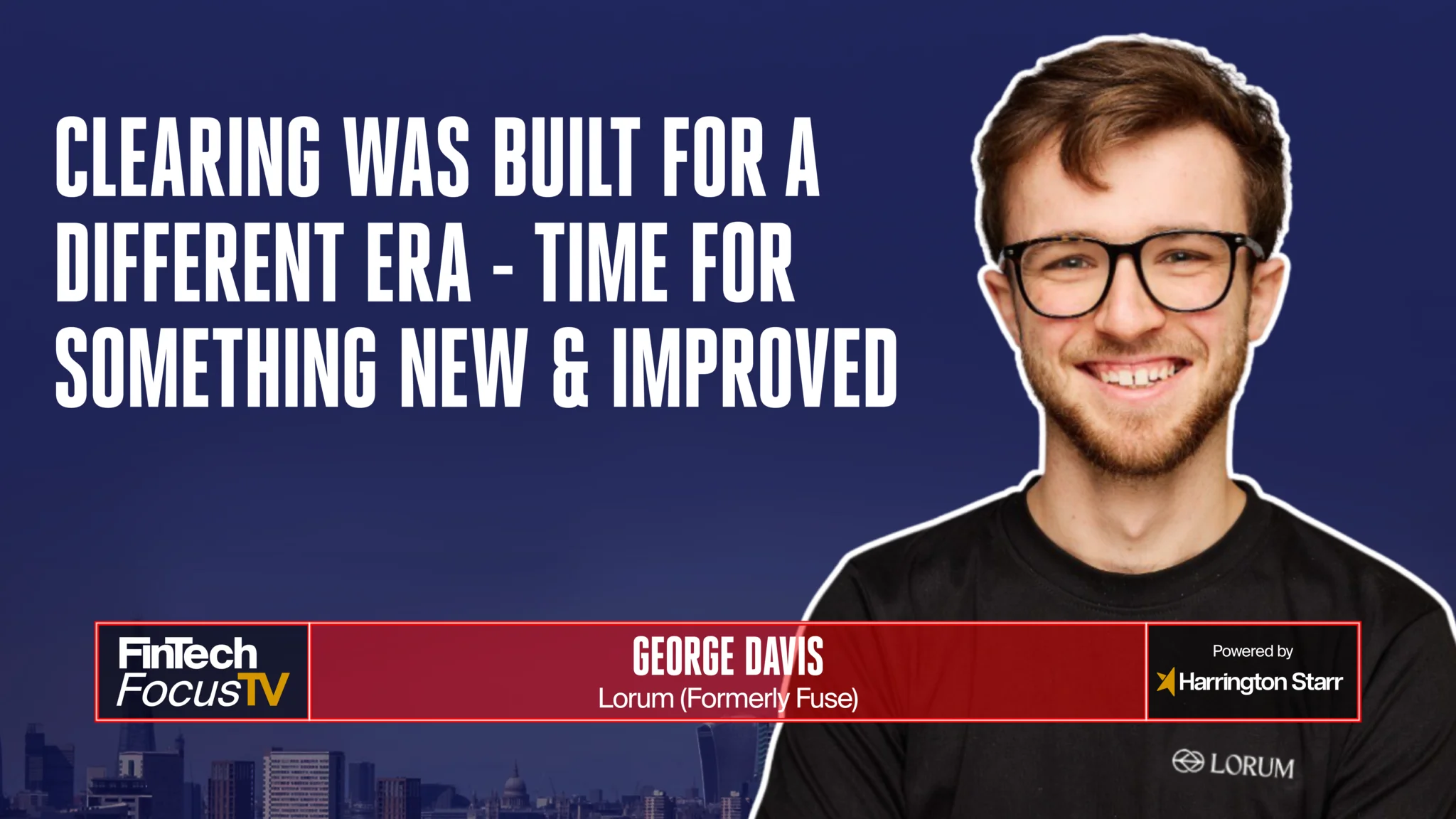
On this episode of FinTech Focus TV, Toby is joined by George Davis, Co-Founder and CEO at Lorum (formerly Fuse), for a deep and wide-ranging conversation on why global clearing infrastructure was built for a different era, and why the financial services industry now urgently needs something new.
As financial services continue to scale globally, legacy clearing and correspondent banking models are being pushed far beyond what they were ever designed to handle. In this discussion, George Davis draws on his experience as a multi-time founder and operator in payments and financial infrastructure to explain why the problem is not Swift itself, but the outdated layers surrounding it. The episode explores how clearing actually works behind the scenes, why emerging markets remain underserved, and what it really takes to build modern, reliable clearing infrastructure at global scale.
For FinTech leaders, payments professionals, and hiring managers building teams in financial infrastructure, this conversation provides rare insight into the systems that underpin the movement of money worldwide.
Early in the episode, Toby sets the scene by highlighting the scale of change currently underway in the clearing space. While innovation in FinTech has accelerated rapidly over the past decade, the foundational infrastructure that enables payments to settle across borders has not evolved at the same pace. According to George, this mismatch is now one of the biggest constraints on global financial innovation.
Drawing on his background running payments at TrueLayer and later co-founding BVNK, George explains that clearing infrastructure is often misunderstood. Many in the industry are quick to label Swift as slow or broken, but he challenges that assumption. In reality, money moves extremely fast at the intermediary level when tier-one banks such as Citi, Standard Chartered, JP Morgan and Barclays are involved. The real bottleneck occurs at the first and last mile, where correspondent banks handle local collection and delivery.
These correspondent banks are not payments specialists. Their primary function is lending and deposit accumulation, not real-time payment delivery. As a result, payments slow down, become opaque, and are forced through processes that were never designed for modern instant or near-instant settlement. This creates friction for FinTechs, financial institutions, and end users alike.
George argues that clearing should not be treated as a local-only function. In a global financial system, clearing infrastructure needs to operate seamlessly across borders, currencies, and jurisdictions. That belief became the foundation for what would eventually become Lorum.
The conversation then turns to the origins of Lorum and the motivation behind building a global clearinghouse rather than another layer on top of existing systems. George explains that while Europe has benefited from modern clearing banks such as ClearBank and Banking Circle, these solutions largely stop at regional borders and still rely on restrictive underlying structures.
In emerging markets, the challenge is even greater. During his time scaling BVNK across multiple regions, George saw firsthand that there was no reliable clearing infrastructure in many parts of the world. FinTechs and banks were forced to sit on top of dozens of payment providers with inconsistent quality, varying standards, and limited control over settlement. In many cases, stablecoins were being used not because they were ideal, but because traditional rails were inadequate.
Rather than accept this as inevitable, George and his co-founders asked a fundamental question: what if clearing could be done directly at the first and last mile using central bank rails, while still leveraging the parts of the existing global network that work well? That question ultimately led to the creation of Lorum.
The goal was not to replace Swift or build another remittance-style business, but to create a high-quality clearing platform that prioritises reliability, transparency, and consistency across markets. Every account should be created in the name of the end customer. Every payment should arrive where it is supposed to, when it is supposed to, without caveats.
One of the most compelling parts of the episode focuses on why Lorum chose to launch in the Middle East, despite the challenges associated with operating in emerging markets. According to George, the region represented the greatest opportunity to add value quickly. The Middle East has enormous monetary flow, significant remittance corridors, and deep sovereign wealth, yet historically lacked modern clearing infrastructure.
George shares a striking early example of the region’s infrastructure gap. After securing regulatory approval in the UAE, Lorum’s first live bank still required paper forms to be printed, signed in ink, and couriered to a branch in order to make payments. This highlighted just how much foundational work needed to be done.
Rather than attempting to manage this remotely, George and his co-founder James relocated to Dubai. They built the business on the ground, working directly with regulators and financial institutions. This local presence proved critical. In markets like the Middle East, relationships, regulatory understanding, and cultural context are just as important as technical capability.
George explains that many global payments businesses fail in these regions because they attempt to scale using minimal local staffing. For clearing infrastructure, that approach simply does not work. To operate effectively, you need to understand how money moves, how central banks function, and how politics and regulation shape financial systems. Lorum’s commitment to being embedded locally became a competitive advantage.
As Lorum gained traction in the Middle East, customer demand began to drive rapid international expansion. One of the biggest catalysts for growth came with the launch of US dollar virtual accounts. George admits that the scale of demand surprised even the team. Within weeks, the dollar product accounted for the majority of Lorum’s business, growing at extraordinary month-on-month rates.
What became clear was that the clearing problem was not confined to emerging markets. Outside the US, it is remarkably difficult to create US dollar accounts in the name of end customers that sit close to settlement rails and behave consistently. By solving this problem, Lorum unlocked use cases across Africa, Asia, Europe, and even within developed markets.
The conversation highlights a broader industry issue: most FinTechs build exciting products at the top of the stack while relying on a small group of tier-one banks for clearing and settlement. These banks are not incentivised to innovate quickly, leaving infrastructure stagnation as a systemic risk. Lorum’s approach aims to modernise this neglected layer.
As Lorum scales, it is building full regional operations rather than operating as a thin global overlay. The business is establishing teams in North America, Asia-Pacific, and Europe, ensuring that clearing infrastructure is developed with local expertise while maintaining global consistency.
From a talent perspective, the episode offers valuable insight into how high-growth FinTech infrastructure companies build teams. George reflects on the challenges of scaling from a lean founding team to a rapidly growing organisation. Lorum grew deliberately slowly at first, raising a relatively modest pre-seed round and focusing on capital efficiency.
However, rapid customer adoption forced a shift. Over a short period, the team expanded significantly to support regulatory, technical, and operational demands. George describes this transition as both challenging and energising. Rather than solving every problem himself, his role evolved into identifying issues and empowering others to solve them.
A key early hire proved especially impactful. Lorum’s fourth employee was a Chief Compliance Officer with deep regulatory experience from the FCA, Facebook, and large financial institutions. This decision accelerated licensing timelines and built trust with enterprise clients and regulators alike. For FinTech businesses operating in complex regulatory environments, compliance leadership is not a support function but a strategic differentiator.
For FinTech recruitment specialists like Harrington Starr, this episode reinforces the importance of hiring experienced leadership across compliance, engineering, payments, and infrastructure. As clearing and payments become more complex, demand for specialised talent continues to rise globally.
Beyond infrastructure and regulation, George speaks candidly about culture and leadership. He explains that Lorum’s culture is intentionally direct, open, and fast-moving. Clear communication and radical candour enable the business to move quickly and avoid the friction that often slows scaling organisations.
This approach resonates strongly in the current FinTech hiring market. According to George, top talent is increasingly motivated by purpose and impact rather than superficial perks. Engineers, product leaders, and payments specialists want to work on meaningful problems with long-term significance. Rebuilding global clearing infrastructure offers exactly that.
As Lorum continues to grow, the company prioritises in-person collaboration through regional hubs. While remote work has its place, George believes that building infrastructure businesses requires close, hands-on teamwork, particularly during periods of rapid expansion. The company brings teams together regularly to maintain alignment and momentum.
Looking ahead, George outlines an ambitious vision for Lorum’s future. The next phase of growth focuses on scaling licensing, expanding currency coverage, and building a broader treasury and transaction banking platform. The long-term goal is to offer the kind of comprehensive clearing and cash management services traditionally associated with global banks but built with modern technology and global reach.
The episode concludes with a clear message: clearing infrastructure is foundational to the future of financial services. Without reliable, transparent, and scalable clearing, innovation at the top of the stack will always be constrained. By rethinking clearing from the ground up, Lorum aims to unlock the next wave of global FinTech growth.
For FinTech leaders, infrastructure specialists, and organisations hiring across payments, data, engineering, and compliance, this conversation offers both strategic insight and a reminder that the most important innovations often happen beneath the surface.