Building Resilient Careers in Financial Technology
26 March, 2026


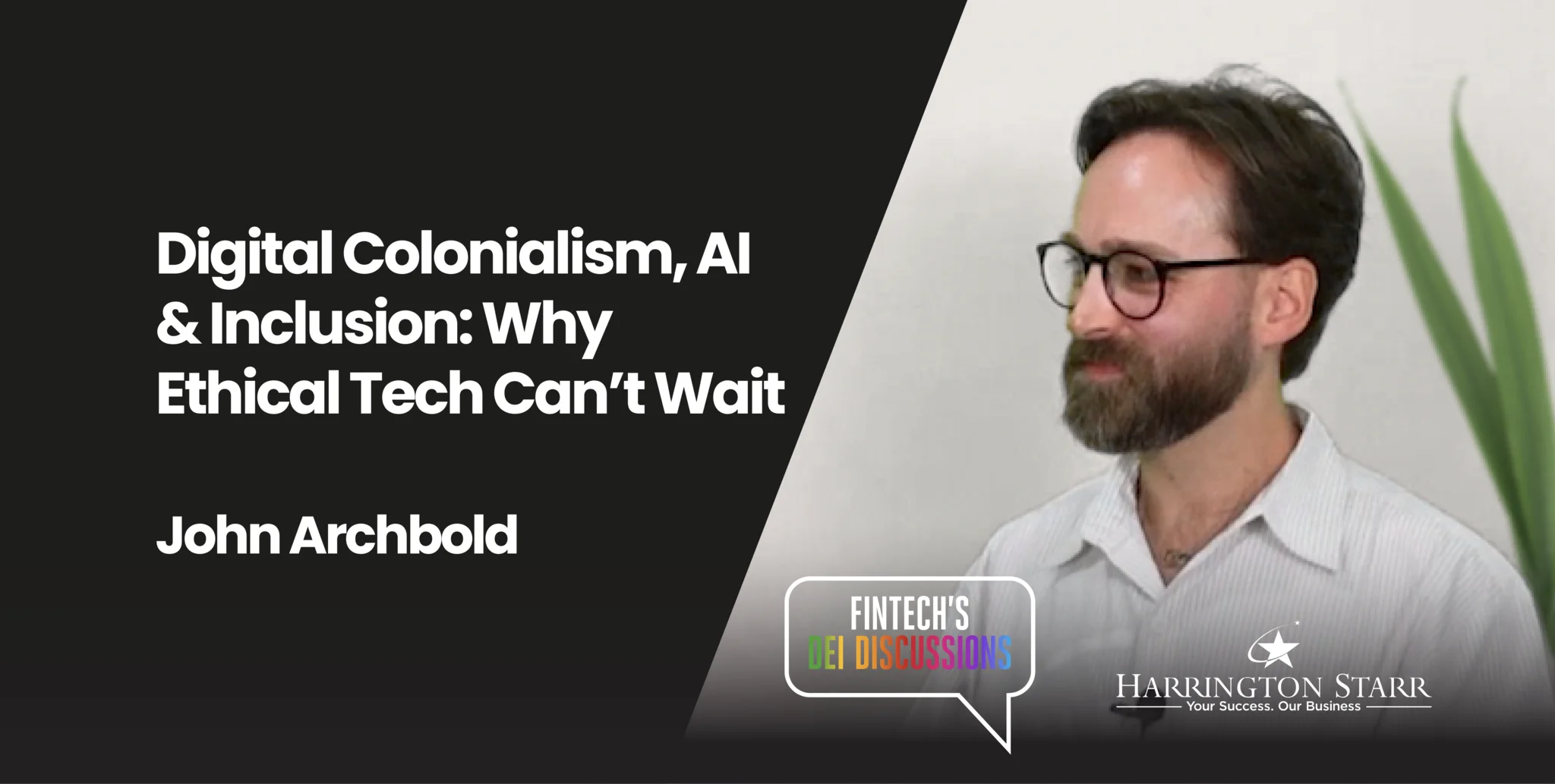
In this episode of FinTech’s DEI Discussions, Nadia welcomes John Archbold, who describes himself as a professional overthinker for AI ethics, governance and the intersection with technology operations. John’s perspective is shaped by over thirty years of experience across technology and cybersecurity within financial services and major asset management environments. As AI continues to transform the FinTech landscape, this conversation brings to the forefront how technology influences people, workplaces and society, and why inclusion, ethics and governance are now inseparable from the future of financial technology.
For Harrington Starr, a FinTech recruitment business supporting clients across technology operations, cybersecurity, data, product and software engineering, this episode offers vital insight into how evolving technology trends intersect with inclusion, culture and the future of hiring. As AI reshapes FinTech jobs, skills and organisational responsibilities, John’s reflections provide a grounded understanding of the human implications behind these shifts.
John begins by describing the development of his thirty-year career in technology, beginning in his teenage years and advancing into significant cybersecurity roles across the financial services sector. He reflects on how dramatically technology has evolved, referencing milestones such as the deployment of personal computers, early versions of Windows and the emergence of cloud technology. Each innovation has reshaped the demands placed on technology teams, but the arrival of AI marks a new phase altogether.
Unlike previous waves of technological change, AI introduces considerations that extend beyond efficiency or productivity. It raises questions about impact on society, fairness, ethical responsibility and the lived experiences of people interacting with AI systems. John explains that the pace of AI development is now so rapid that it requires ongoing reflection, and this is why he identifies as a professional overthinker. For him, thinking deeply about AI’s effect on people, organisations and the global environment is not optional; it is an essential part of responsible leadership in the technology sector.
While John’s career has been deeply rooted in engineering and cybersecurity, inclusion has been central to his approach since the very beginning. He recalls that one of his earliest decisions in the workplace was to be open about his sexuality and his experiences as a gay man in the financial sector. He emphasises that not every LGBTQ+ professional wants to take on an advocacy role, nor should they be expected to, but being open allowed colleagues to ask respectful questions and learn from his experiences. This contributed to a more inclusive working environment and helped challenge assumptions in teams that were often dominated by straight men.
As he progressed into management, inclusion became part of his decision-making process. He describes joining a company where hiring practices prioritised candidates from red brick universities. Coming from a disadvantaged background himself and not following that pathway, he immediately removed this requirement. Instead of privileging university names, he focussed on capabilities and potential. This simple change opened doors for candidates who had taken different routes into education or the workplace, including those who had not attended university. His hiring approach helped create opportunities for people who simply needed someone to take a chance on them, aligning with broader FinTech recruitment goals around widening access to talent.
John also reflects on the lack of women in technology roles earlier in his career, especially in operations and infrastructure, which were heavily male-dominated. He recalls raising the issue with a recruitment colleague who suggested that hiring more women would only mean taking them from other companies. John rejected this narrow view and chose instead to expand the entry routes into technology.
When he later took responsibility for desktop support and service desk functions, he intentionally prioritised hiring junior women from STEM fields or those considering a career pivot. His aim was to increase the overall percentage of women in technology by developing new talent rather than redistributing existing talent. He explains that by focussing on potential and creating entry-level pathways, teams could become more diverse and more reflective of society. Nadia highlights how this approach applies across all underrepresented groups, reinforcing the need for organisations to think beyond quick fixes and invest in widening access across the industry.
As the conversation shifts to AI, Nadia asks John to explain the term digital colonialism, a concept increasingly referenced in discussions around global technology ethics. John provides an overview based on the definitions used by researchers and communities most affected, emphasising that the term stems from the continued disenfranchisement of people in the Global South by companies based in the Global North.
He offers examples rooted in the real-world impacts of AI development, such as content moderation and data labelling. These roles require workers to review large volumes of harmful, explicit or distressing content, often under intense time pressure and with minimal rest. John notes that while some companies claim to offer mental health support, working conditions can still be exploitative.
He highlights that just as the Fairtrade movement emerged when consumers became aware of the unethical conditions behind everyday products like coffee and textiles, society must now confront how digital technologies rely on labour practices that remain largely invisible to the public. The notion of “fair data”, as Nadia terms it during the conversation, parallels this shift toward ethical awareness. Understanding these issues is especially relevant to FinTech organisations building or deploying AI-driven solutions, as these technologies are ultimately shaped by data and labour sourced from across the world.
Another central theme explored in the episode is the disproportionate impact that algorithms and AI systems have on underrepresented groups. John references Weapons of Math Destruction, a book he recently read, which discusses how algorithms influence society far more than most people realise. Although AI may feel like a new trend, algorithms have quietly shaped decisions in areas such as policing, advertising and hiring for many years.
John shares his own recent experience applying for jobs after redundancy, noticing how applicant-tracking systems may disadvantage certain groups. He discusses how queer-coded language can be interpreted differently by AI tools, potentially affecting how candidates are screened. He also expands on issues relating to facial recognition systems, noting that these tools often produce higher false-positive rates for darker-skinned individuals due to limited representation in training datasets.
This episode gives examples of how postcode data and other indirect indicators can infer characteristics such as ethnicity or community if organisations are not careful, reinforcing structural inequities. These issues are especially relevant for FinTech, where AI increasingly informs decisions about fraud detection, compliance, onboarding and customer assessment. For recruitment and talent strategies within financial technology, John’s comments highlight why inclusion cannot be separated from AI governance and why businesses must understand how algorithmic bias shapes opportunities and access.
Nadia and John discuss the important role that internal employee networks can play in shaping responsible AI practices. John clarifies that not every individual from a marginalised group needs to take on advocacy, but networks can collectively raise awareness about how technology impacts different communities.
He suggests that networks such as LGBTQ+ groups, women’s networks or Black employee groups can start by discussing how technologies used within their organisations affect them. For instance, HR systems could inadvertently screen out certain types of language or patterns associated with their communities, and facial recognition systems could behave differently depending on skin tone.
John encourages employee networks to engage proactively with AI governance boards where they exist. Because AI governance is still an emergent discipline with people joining from technology, legal, research and ethical backgrounds, there is space for employee networks to contribute meaningfully. This involvement helps ensure that a company’s approach to AI considers real-world harms rather than theoretical future risks. For FinTech organisations deploying high-impact systems, such engagement supports ethical leadership and promotes more inclusive practices across hiring, technology operations, and broader business decision-making.
When Nadia asks what individuals can do if they do not have access to employee networks or if they are job seekers trying to promote inclusion, John emphasises the importance of open, respectful dialogue. He points out that many people only become aware of AI’s impact once they personally encounter a challenge, whether through hiring systems, algorithmic content filters or other technologies that shape daily life.
John places particular emphasis on the role of allies. While marginalised communities experience the greatest impact, allies often have more influence within organisations and can drive conversations forward. Allies can help raise awareness, advocate for responsible use of AI and support inclusive practices across teams. For FinTech companies undergoing rapid technological transformation, allyship becomes a critical part of maintaining workplace fairness and supporting inclusive growth across technology operations, change functions and engineering teams.
Toward the end of the episode, John raises concerns about organisations using AI in ways that may limit opportunities for early-career professionals. He mentions hearing about companies that rely heavily on AI rather than hiring junior staff, choosing only to employ more senior professionals. While John acknowledges AI’s potential to improve productivity, he encourages leaders to think carefully about the long-term impacts of such decisions.
Removing junior opportunities affects the diversity of the workforce and influences how people build careers in technology. This is especially relevant for FinTech recruitment, where early-career roles provide essential pathways for future engineers, technologists and leaders. If organisations rely too heavily on automation and reduce entry-level hiring, the talent pipeline becomes narrower and less reflective of society, affecting both inclusion and long-term capability.
As Nadia closes the episode, she thanks John for bringing critical issues to the forefront. From digital colonialism to algorithmic bias, from early inclusion efforts to the implications of AI governance, the conversation provides a comprehensive look into the challenges and responsibilities facing today’s FinTech organisations.
For Harrington Starr and the wider FinTech recruitment community, this episode highlights how hiring, culture and technology strategy are deeply interconnected. As AI continues to shape the sector, companies must prioritise responsible deployment, inclusive thinking and ethical leadership to build a thriving, representative workforce.
The episode concludes with a reminder of the podcast’s purpose: to listen, to learn and to walk the talk. With voices like John’s contributing thoughtful, experience-driven insights, FinTech organisations have an opportunity to create workplaces where technology supports fairness, inclusion and long-term success.