AI, Mega Rounds & Fintech Venture Capital in 2026
11 March, 2026


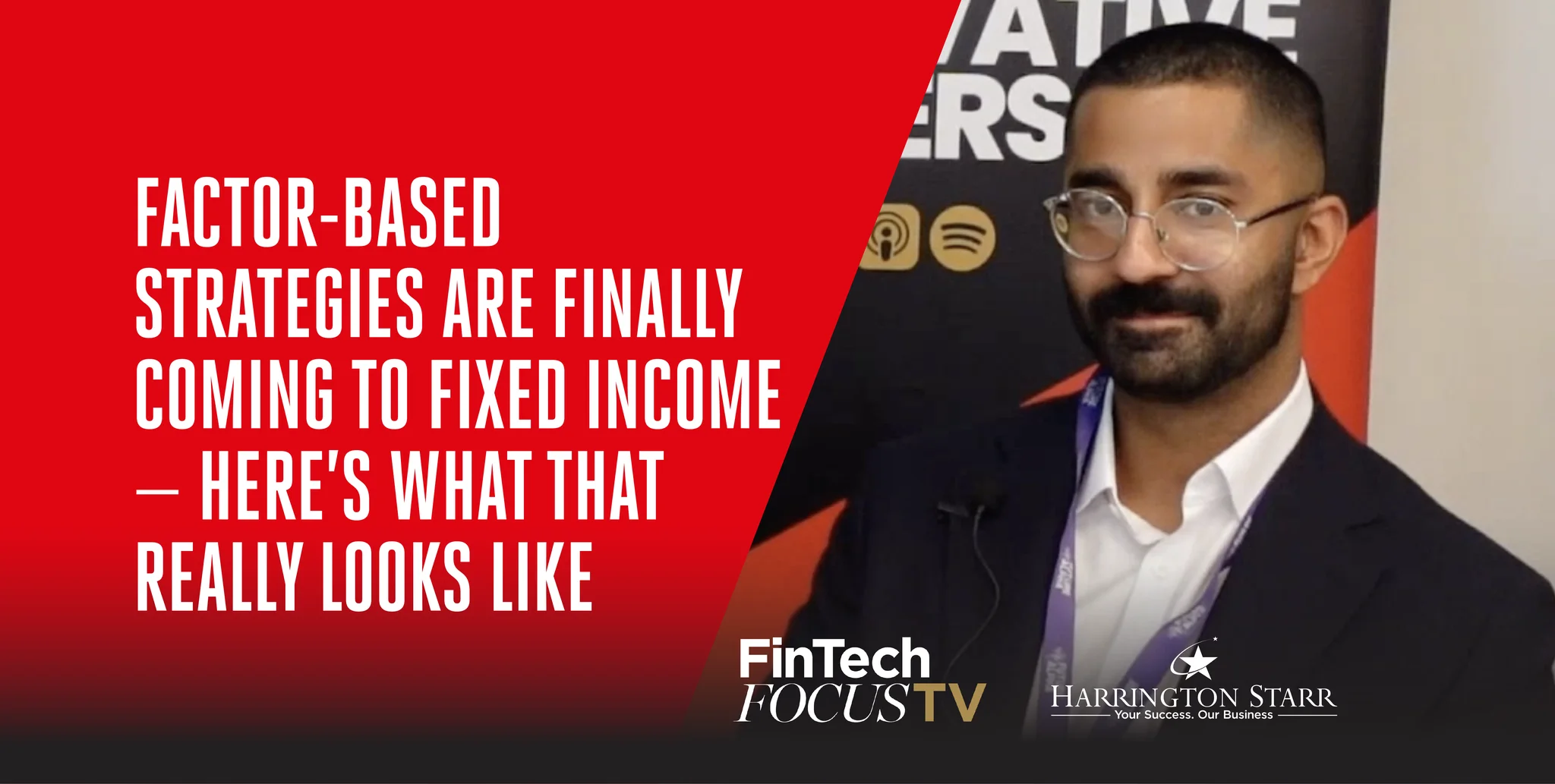
Recorded live at Quant Strats 2025, this special episode of FinTech Focus TV brings together host Oli and guest Hamza Chaudhry, Fixed Income Quantitative Researcher at AllianceBernstein, to explore an asset class that has long been overlooked in systematic trading: fixed income. In a conversation filled with candour, nuance, and lived experience, Hamza breaks down the reality of systematising fixed income and rates markets, the factors shaping its accelerated development, and the challenges that remain in creating investable, quantitative strategies at scale. As a FinTech recruitment business, Harrington Starr has long understood the deep connection between talent, innovation, and market evolution. In this episode, the talent story is deeply embedded in the technology and research story, echoing broader trends in FinTech hiring, quant talent development, and the future of financial markets.
Oli begins by directly addressing the position of fixed income within the broader quantitative space. In the world of systematic strategies, fixed income has historically been underrepresented both in practical application and academic literature. The lion’s share of quant innovation, research, and commercial application first emerged in equities. As the host frames it, the core conversation is about why the systematic world developed as it did and how fixed income is now catching up. Hamza’s perspective is immediate and grounded in practice. He explains that the major trend has always been equity-focused, starting with the influx of quantitative minds into equity markets. The equity space quickly evolved, creating deep, well-established research pipelines and communities of practice. Fixed income, he explains, “for various reasons has not had that yet.” This sets the foundation for the episode: a quant domain in its early stages of systematic transformation rather than one that has already matured.
Hamza emphasises that this shift is only just beginning. The fixed income landscape is now producing “really cool papers, really cool research” that align much more closely with what practitioners see in real trading environments. He stresses that this wasn’t always the case and that historically there was “a divide” between academic literature and real-world practice. Today, those gaps are starting to close. The excitement comes from the fact that fixed income remains “uncharted territory.” Unlike equities, fixed income cannot simply be treated as a one-to-one transplant of the equity systematic model. There is “a lot of stuff that you can’t just port over from equities,” and the very structure of fixed income markets requires novel thinking rather than retrofitted templates.
The conversation moves into structural and institutional barriers that affect systematic adoption. Oli asks whether systematising fixed income introduces unique challenges. Hamza outlines two key dimensions: the trading layer itself and the liquidity environment in which models must execute. A great deal of fixed income trading remains “OTC over the phone, or through Bloomberg,” even as electronic execution improves. He offers specific data points: around 60 per cent in US investment grade is systematised, with European investment grade materially lower. This gap between electronic adoption and market behaviour creates practical consequences for anyone deploying quantitative strategies.
After research and signal generation, execution becomes the critical bottleneck. You may have identified profitable sources of alpha or constructed signals for credit or rates, but “you have to really consider the liquidity side of it because you may not be able to execute onscreen prices or even what your traders are seeing.” This dual-layer problem is central to the fixed-income quant profession. Unlike equities, where execution quality is dramatically easier to evaluate, fixed income requires an ongoing negotiation between model intent and market realities. Liquidity constraints can be the difference between theoretical alpha and real-world underperformance. The limitations are not symmetrical across assets. FX, for example, is more liquid. Hamza notes that AllianceBernstein maintains a long-short FX strategy, though he does not manage it. His own work centres on systematic credit and rates, both of which sit closer to the pain points his research describes.
The liquidity discussion is a powerful reminder that even the most elegant model must confront the operational side of financial markets. For hiring leaders, particularly those recruiting quant researchers or systematic portfolio managers, this becomes a meaningful insight. The technical competence required in this area is not limited to coding, back-testing, or factor design; it demands behavioural understanding of execution channels, credit market microstructure, and the reality of trading workflows. For companies operating in FinTech, investment technology, or systematic asset management, this emphasis on liquidity-aware research is an indicator of priority hiring domains: researchers who understand data, infrastructure, and constraints, not just theory.
Oli pivots to a core theme of Hamza’s Quant Strats presentation: factor-based modelling. For audience members unfamiliar with factor work, Hamza explains its intellectual lineage. He traces it to the Fama-French three-factor model, in which signals such as momentum or quality can be fed into optimisation to build portfolios bottom-up, subject to constraints. This approach is widely respected and widely utilised in equities, commodities, and some FX strategies. But it is only “just started to come into fixed income,” setting the stage for new research requirements that do not exist in more established systematic domains.
Hamza then articulates one of the most important and under-discussed issues in financial research: reproducibility. Even where papers exist, “there is kind of a reproducibility crisis,” which he plans to speak about in his conference session. The “vast majority” of research cannot be used because researchers are “not able to reproduce it.” This leads to a form of self-driven innovation, in which practitioners must “push that ball forward” and develop their own frameworks, test their own theories, and validate signals against real market conditions.
This is more than a technical frustration; it has implications for hiring, training, and innovation pipelines. Organisations that want to compete in systematic fixed income must support environments where researchers are expected to do genuine discovery, not derivative replication. That in turn requires recruitment processes that can identify curiosity, independence, and original thinking. Teams that depend solely on pre-existing research or academic literature will struggle to scale or differentiate. Harrington Starr’s position in the FinTech recruitment market is relevant here: clients who want high-performance systematic researchers increasingly look beyond brand names and toward individuals who can build from scratch when there is no trustworthy codebase, paper, or benchmark.
Oli shifts the conversation to the human dimension of innovation. He asks whether the influx of people from “less obvious backgrounds” contributes to the evolution of systematic fixed income. Hamza’s answer is immediate: yes, “for sure.” He frames this as a broader quant trend. You do not need deep financial knowledge to enter the field. You can acquire finance on the job. Meanwhile, what organisations often need is perspective. Coming from crypto, economics, or “something completely left field” provides different ways of thinking that are extremely valuable when the research frontier is not saturated.
In fixed income, there is not a large archive of tried-and-tested strategies. There are not decades of well-supported pipelines as in equities. You “really do need people to come up with those ideas and see things in a different way.” Crypto engineers, data scientists, or ML specialists who pivot into systematic finance often outperform expectations because they are not burdened by inherited assumptions. They question the unwritten rules that discretionary traders maintain. They experiment in spaces where no copy/paste model exists. This flexibility is especially useful in systematic credit, where signal construction, factor validation, and execution all require original experimentation.
When Oli asks whether bias or intellectual isolation has historically affected fixed income, Hamza draws a parallel to the “old school equity market.” He argues that this was more prevalent on the discretionary side, where professionals often sat within the same asset class for decades. Things have changed significantly since the financial crisis. Now the space is more open. Hedge funds, master managers, and large research groups publish posts and technical notes. AQR is a notable example, and the Sparklike QPS team equally contributes. These organisations help create dialogue, and “getting a lot of people involved in talking about this space in general does help evolve it and move it forward.”
Oli extends this discussion to Hamza’s role as an advisory board member at Quant Strats. He highlights a broader trend moving away from secrecy. Podcast appearances from figures like Cliff Asness or Steve Cohen illustrate how leaders are now more willing to share their thinking publicly. Hamza appreciates this shift. He finds it “fun to talk about the stuff that you work on every day.” Sharing research “brings a lot of visibility” to an asset class most people ignore in favour of equities, even though there is significant opportunity, especially when the market is young. Visibility drives talent discovery, broader collaboration, and collective innovation.
From a recruitment standpoint, this is a foundational observation. Quant finance used to be insular. Today, success increasingly depends on communities, meetup groups, advisory roles, open-source code, and professional content. Organisations that embrace openness attract younger talent, generate inbound hiring momentum, and accelerate innovation cycles. Industry engagement is no longer a luxury; it is a competitive advantage.
As the episode progresses, Oli and Hamza reflect on what they expect from Quant Strats. AI and “agentic modelling” will appear everywhere, but Hamza is particularly curious to see whether any of the other panellists will discuss the negatives. He acknowledges AI’s utility. He has used it every day since it emerged because it speeds up the research process significantly. There are “really cool stuff” possible with agent AI. But with benefits come limitations, and those are rarely acknowledged. He is interested in hearing whether anyone on stage will address them.
Oli agrees. He reflects that much AI rhetoric at industry conferences has been “a bit hypothetical,” treated as a joke or novelty rather than as a practical research tool. He hopes Quant Strats will instead focus on case studies and real experience. Hamza echoes this. There is a need for “a nuanced discussion,” rather than reactions that are either naïvely positive or dismissive. These insights reflect an evolving maturity curve. AI, instead of being a meme topic, is becoming a productivity engine and a strategic tool. For talent leaders, this means the profile of the ideal quant is shifting. Candidates who only understand traditional models may be outpaced by those who use AI as a research accelerator.
For younger professionals, Hamza offers grounded guidance rooted in his own experience. Curiosity is the most important asset they have. Students should not limit themselves to classroom material; they must apply it. Building coding projects and developing personal strategies can accelerate development. Even trading with real money helps because it introduces risk and emotional investment. When a quant has “skin in the game,” they care more about the numbers they are working with. They are forced to treat research outcomes differently.
He also advises aspiring quants to reach out to people in the industry. Speaking with alumni or practitioners bridges the gap between academic literature and practice. There is “a big disconnect,” and talking to those working in the field helps align expectations with reality. People are open to discussing their work. This is a reminder that networking is not a formality; it is a necessary mechanism for learning.