AI, Mega Rounds & Fintech Venture Capital in 2026
11 March, 2026


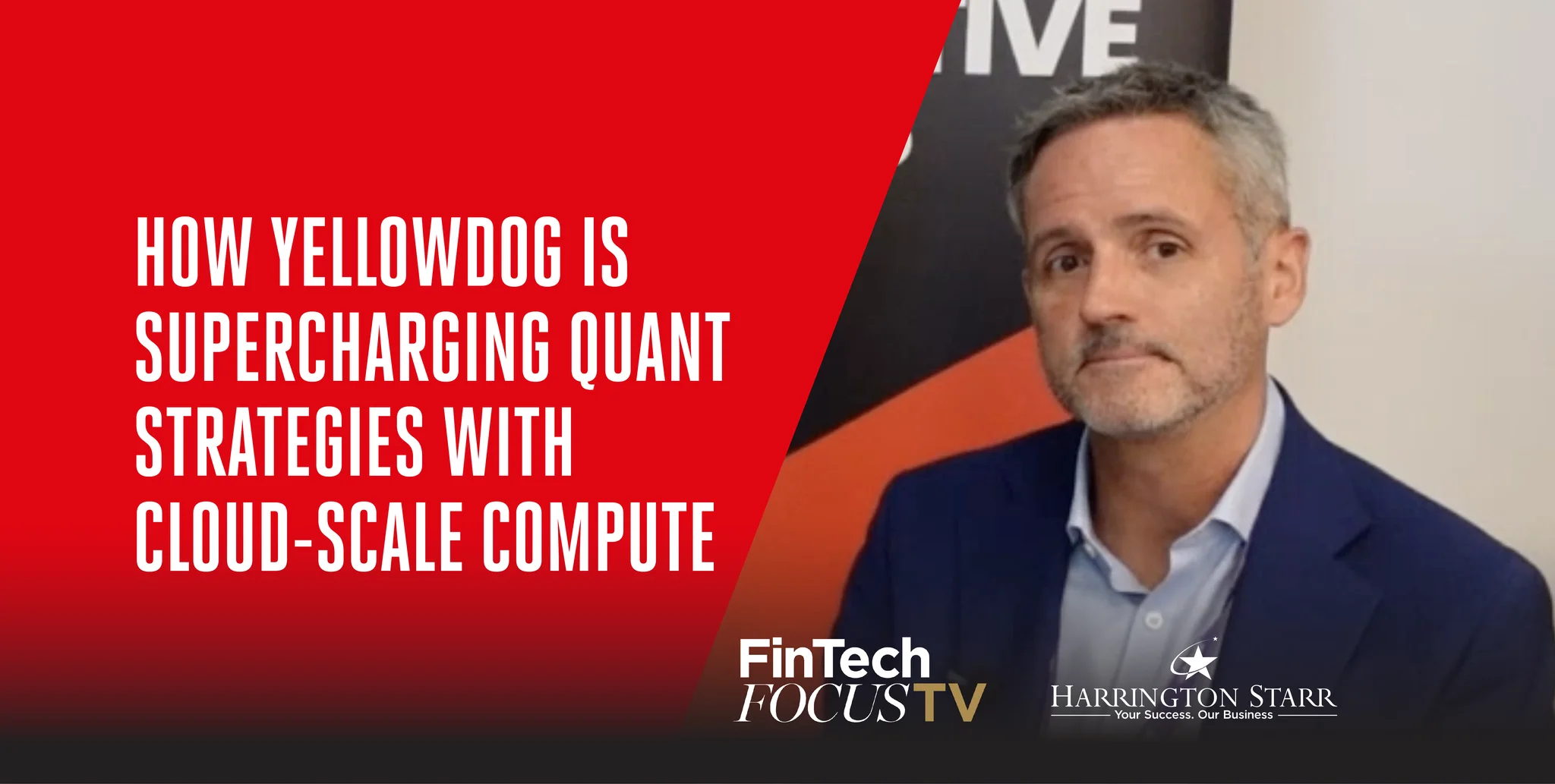
FinTech Focus TV, hosted by Lucia, returned to Quant Strats 2025 for a conversation that explores one of the most pressing challenges in modern financial technology: how research and trading teams can scale compute, accelerate simulations, and build infrastructure capable of supporting new AI-driven investment strategies. Joined by Bruce Beckloff, CEO at YellowDog, the episode provides a comprehensive look at the relationship between cloud computing, high-performance compute orchestration, quant research, and the future of financial services. As a global recruitment business working closely with firms building these capabilities, Harrington Starr recognises the importance of understanding where technical and quantitative teams are heading, particularly as compute-heavy models become essential in generating competitive alpha.
Lucia sets the stage by welcoming Bruce and asking him to introduce YellowDog to anyone still unfamiliar with the company. His explanation immediately highlights why their work sits at the centre of some of today’s most advanced quantitative finance strategies. YellowDog is a “dynamic workload manager,” a term that Bruce admits is a bit of a mouthful, but describes precisely what the platform delivers. The company enables quant hedge funds, and a growing number of other hedge fund strategies, to build very large-scale compute environments in the cloud, allowing research and trading teams to run simulations at speeds and scales that were previously impossible or financially impractical.
The conversation quickly evolves into a deep dive into cloud strategy, workload mobility, and the infrastructure pressures currently shaping the quantitative finance landscape. Throughout the discussion, Bruce shares how his team supports hedge funds as they balance between on-premise compute and cloud compute, and how YellowDog helps solve challenges related to capacity, cost-efficiency, automation, and operational complexity. For Quant recruitment specialists like Harrington Starr, who support hedge funds scaling their technology and quant teams, this type of insight is invaluable.
At the core of this episode is an exploration of how quant hedge funds are rethinking compute strategy. Lucia asks Bruce about the cloud aspect of YellowDog’s work and how it contributes to faster and more efficient computational workloads. Bruce acknowledges that the industry remains divided: some hedge funds rely on traditional data centres, while others lean into flexible cloud computing. Many adopt hybrid strategies, using on-premise resources for predictable, constant-use compute and cloud resources for burst compute requirements.
Bruce explains that quant teams often need tens of thousands of machines for only short periods of time, sometimes an hour a week, sometimes an hour a day. Purchasing that level of infrastructure outright would be prohibitively expensive, which is why cloud computing has become central to modern quant strategies. However, as he points out, cloud access can come with its own challenges, including capacity limits and GPU scarcity in certain regions. YellowDog resolves these issues by automating and orchestrating compute environments across multiple clouds and multiple regions, providing quant teams with the compute they need precisely when they need it.
This level of capability is particularly relevant for the Quant talent market. As quant trading firms increase their reliance on heavy computation, roles in quantitative development, infrastructure engineering, cloud optimisation, and high-performance computing continue to climb in demand. Harrington Starr’s clients increasingly seek professionals capable of managing or contributing to these compute-intensive environments, and this episode highlights why those skills are now essential.
Building extremely large compute clusters doesn’t just require the right infrastructure; it requires exceptional talent. As Bruce explains, one of the most significant challenges YellowDog is solving is the complexity behind making thousands, tens of thousands, or even one hundred thousand computers work together seamlessly. The industry often references Elon Musk’s attempts to build colossal supercomputers, and while hedge funds may not be building something at that scale permanently, many are building supercomputers temporarily, on demand, through the cloud.
This temporary but enormous scale enables quant teams to run sophisticated backtests, Monte Carlo simulations, or AI-powered modelling processes much faster than traditional setups. The ability to conduct quick iteration, test new ideas, and scale successful approaches rapidly gives hedge funds a competitive advantage in alpha generation. These demands have clear implications for the Quant recruitment market. Firms require quant developers, data engineers, machine learning specialists, and cloud engineers who can work within environments shaped by distributed systems, high-performance computing, and automated orchestration. Harrington Starr continues to partner with organisations building teams around these exact capabilities.
When Lucia asks Bruce what challenge YellowDog is primarily solving for research and trading teams, he emphasises that while speed is a major factor, the broader issue is complexity. Bringing thousands of machines together, whether on-premise or in the cloud, is difficult, time-consuming, and often laden with manual effort. YellowDog automates this process, allowing trading and research teams to focus on generating alpha instead of managing infrastructure. This need for automation and simplification is another major driver behind the Quant hiring trends Harrington Starr sees globally.
Lucia then shifts the conversation towards AI, asking Bruce about the most exciting developments at the intersection of AI, the cloud, and high-performance computing. Bruce describes AI as a horizontal technology, one that exists across every industry. Whether AI is being used for HR functions, writing tasks, or investment strategies, the principle is the same: it unlocks new efficiencies and capabilities.
In financial services, AI adoption is accelerating rapidly. The industry has embraced its potential not just for research, but also for decision-making, modelling, and operational enhancement. Bruce highlights that organisations are not just using AI models individually; they are scaling them. That scale requires massive compute power, which is exactly where YellowDog plays a pivotal role. The ability to aggregate compute across different types of hardware, CPUs, GPUs, and entire data centre clusters means hedge funds can deploy more ambitious models and strategies.
As compute availability grows, new financial strategies will emerge. For Quant recruitment, this signals continued growth in hiring across AI engineering, ML engineering, and hybrid quant-AI roles. Harrington Starr is deeply embedded in this talent landscape, supporting financial services businesses as they build teams that can navigate the rising complexity of AI-enhanced trading models.
One of the episode’s major announcements is YellowDog’s release of “RayDog,” a new workflow product built around the Ray open-source framework. This new tool connects Ray with YellowDog’s compute-orchestration capabilities, enabling researchers and quantitative traders to access massive cloud compute more easily. For technologists, the significance of this lies in Ray’s design as a tool that simplifies distributed computing. This simplifies experimentation, iteration, and moving successful models into full production.
Bruce highlights how RayDog is designed to give quant teams high-level languages and tools that are easier to program with, allowing researchers to experiment rapidly and scale aggressively when their research yields promising results. This mirrors a broader trend in Quant development: the push for tools that empower teams to accelerate idea-to-production workflows.
This shift influences hiring trends directly. Financial services firms increasingly seek professionals who can work with distributed computing frameworks, understand complex cloud orchestration, and implement scalable AI research pipelines. The intersection between research tooling and infrastructure strategy is becoming a core differentiator for hedge funds competing in the alpha arms race. Harrington Starr continues to support these firms as they expand and refine their technology teams.
As the episode moves towards its conclusion, Lucia asks Bruce to identify the three key takeaways he hopes listeners remember. Bruce begins with scale, something YellowDog has achieved to extraordinary levels. By the end of the month, their platform expects to run between 700,000 and 1,000,000 hours of compute. This level of scale demonstrates that the demand for large-scale compute in quant finance continues to rise sharply.
The second major theme is mobility. Workload mobility allows hedge funds to move their computational tasks across regions, clouds, or resource pools to avoid capacity shortages, especially when GPUs are scarce. This ability is crucial in an environment where compute demand often spikes and where infrastructure availability fluctuates.
The final takeaway Bruce shares concerns the decision many firms face between building their own infrastructure and leveraging a partner. YellowDog automates processes that consume substantial engineering time, allowing quant teams to prioritise alpha-generating activities rather than managing infrastructure intricacies. This mirrors a growing trend in financial services: firms are seeking ways to free their technical and quantitative teams from infrastructure friction so they can focus on strategy development.
Each of these themes, scale, mobility, and automation, aligns closely with the talent needs of the modern financial market. As firms continue to expand compute-driven strategies, the need for specialists in cloud engineering, infrastructure automation, quant development, and distributed computing becomes even more pronounced. Harrington Starr remains at the centre of this evolving recruitment landscape, supporting firms that build world-class quant and engineering teams.
This FinTech Focus TV episode, recorded live at Quant Strats 2025, offers one of the clearest views yet into how compute-driven strategies are shaping the future of financial services. Bruce Beckloff’s insights reveal how cloud infrastructure, AI integration, and high-performance compute orchestration have become fundamental to modern quant research. These trends are defining not only the technology landscape but the FinTech talent market as well.
Every major theme in this conversation, cloud adoption, distributed computing, AI-expanded strategies, modelling at scale, and infrastructure automation, points to accelerating demand for exceptional technical talent. Quant researchers, cloud engineers, AI specialists, and distributed computing experts are increasingly central to hedge fund performance. Harrington Starr remains committed to supporting clients and candidates across this evolving market, helping firms secure the talent that drives innovation in financial technology.
As financial services continue to embrace AI, cloud, and high-performance compute, the intersection of technology and quant strategy will define the next era of alpha generation. Through conversations like this one on FinTech Focus TV, Harrington Starr continues to bring visibility to the innovations shaping the sector, and the talent powering it.