Stop Hiring the Same People
13 October, 2026


Inclusion is often discussed as a social responsibility, but what if businesses started recognising it as an opportunity for growth, innovation and long-term success?
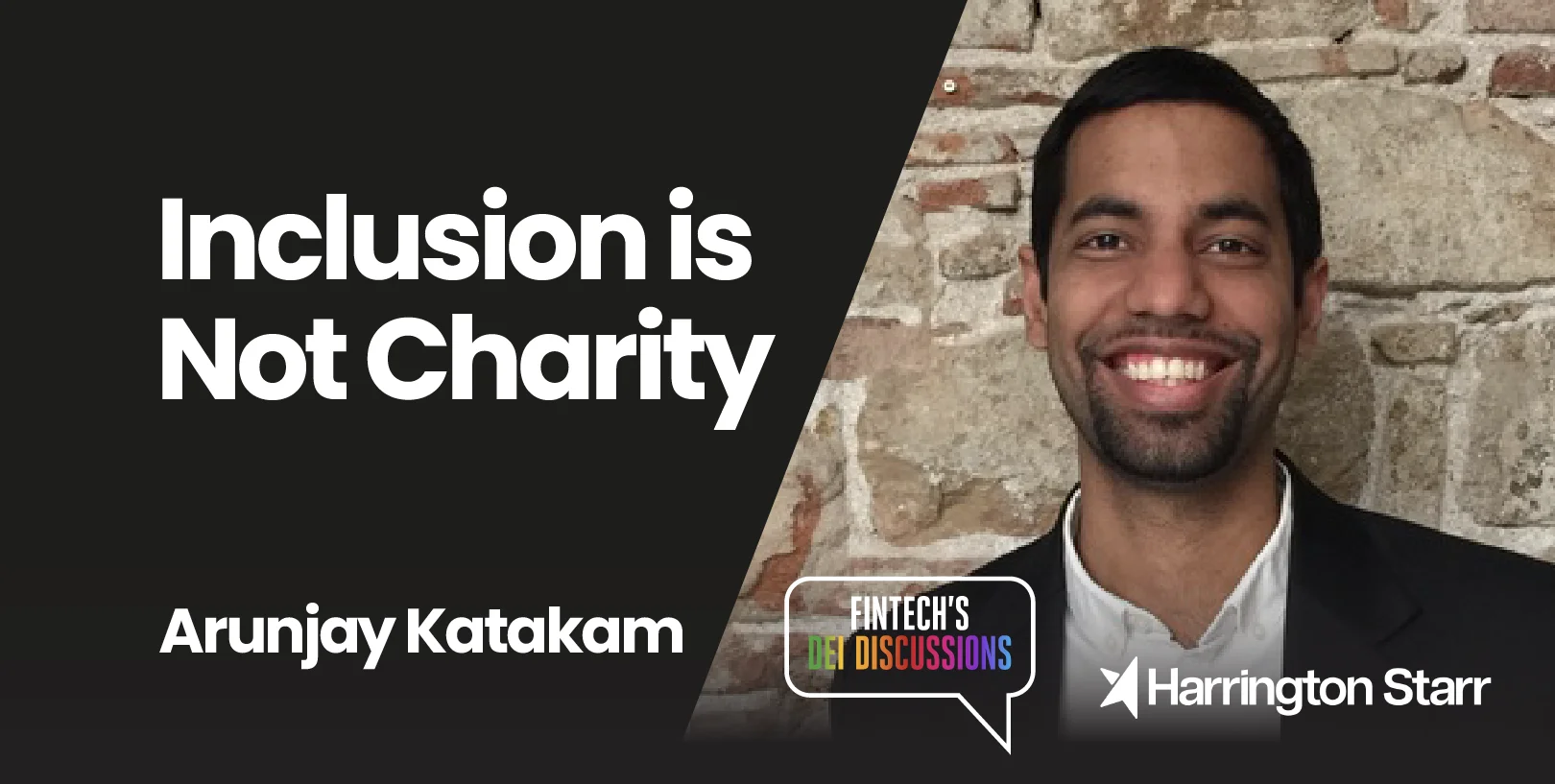
In the latest episode of FinTech's DEI Discussions, host Nadia Edwards-Dashti, welcomes Arunjay Katakam, Author, Founder of Inclusive Action Lab and Co-Founder of ThriveNow Education, for a conversation about financial inclusion, diversity of thought and the future of financial services.
Drawing on his experience in investment banking, financial inclusion and building not-for-profit businesses, Arunjay challenges traditional ideas about wealth, success and the role of businesses in society.
The discussion explores why diversity of thought is essential for innovation, how financial and economic inclusion intersect, and what the convergence of traditional finance, decentralised finance and artificial intelligence could mean for the industry.
At the centre of the conversation is a message that challenges how organisations approach diversity, equity and inclusion.
Inclusion is not charity. It can create meaningful value for businesses and the people they serve.
Arunjay's journey into financial inclusion began with a very different ambition.
From the age of 11, he wanted to become extremely wealthy. That ambition eventually took him into investment banking, where he worked in audit for investment management firms.
However, a conversation with a friend in 2007 made him question whether the pursuit of wealth aligned with his values. His friend suggested that succeeding in the industry required an extreme level of greed, prompting Arunjay to reconsider what he wanted from his career.
He subsequently moved into financial inclusion, although his ambition to make millions remained. At the time, he believed he could combine financial success with making a positive difference.
It was the COVID-19 pandemic that fundamentally changed his perspective.
As the world entered lockdown, Arunjay became increasingly aware of the financial vulnerability facing billions of people. He recalls discovering that approximately four billion people had no financial reserves to fall back on, with many living from one pay cheque to the next.
This prompted him to question why he was waiting to accumulate personal wealth before making a difference.
Rather than spending years trying to become wealthy enough to fund meaningful change, he realised that he could start contributing immediately.
This marked a shift from what he describes as a scarcity mindset to one of abundance.
Today, his work focuses on building not-for-profit startups and making resources open source, which he believes can accelerate positive change.
His experience raises an important question for professionals working across financial services and FinTech. How should success be measured, and what role should purpose play in shaping careers and businesses?
For Arunjay, the answer lies in recognising that financial success and social impact do not have to be opposing ambitions.
Another significant part of Arunjay's story is his experience with dyslexia.
He discovered he was dyslexic at the age of 30, providing an explanation for some of the difficulties he had experienced throughout his education.
Although he had struggled academically, he recognised that he was comfortable working with numbers. This led him towards accounting and subsequently into financial services.
After transitioning into financial inclusion, he secured a role as a data analyst, where his numerical abilities were particularly valuable.
However, a few months into the position, he was asked to start writing about the data he was analysing.
This presented a considerable challenge.
Arunjay describes spending two days repeatedly writing and deleting material before eventually completing his first 600-word blog post.
Despite that difficult beginning, he continued writing articles and reports, eventually publishing his first book in 2019.
He has since written three books, including his latest, The Future of Finance Is Open: A Visionary Tale of the Great Convergence.
His experience demonstrates how skills can develop over time, even when someone initially finds them difficult.
Writing also became an important part of his own learning process. He explains that researching and writing books helped him articulate his ideas, deepen his understanding and explore subjects he might otherwise never have investigated.
For employers, his story provides a useful perspective on neurodiversity in the workplace and the limitations of judging individuals against conventional expectations.
It also connects to his wider criticism of education systems that are primarily designed around neurotypical learners.
Arunjay argues that when people learn or think differently, traditional structures can fail to accommodate them.
His experiences highlight why recognising different abilities and approaches matters, particularly when considering how organisations identify and develop talent.
When Nadia asks what inclusion and equality mean to him, Arunjay reflects on how societies have historically divided people into categories.
Having grown up in India, he references the caste system as one example of how deeply embedded social divisions can become.
However, he emphasises that categorising people is not unique to any one country or culture.
Across the world, individuals are frequently judged according to their background, identity or where they come from.
For Arunjay, genuine inclusion means moving beyond these divisions and recognising the value of different experiences.
This is particularly important within businesses.
He argues that organisations can become trapped in echo chambers, where the same ideas circulate among people with similar backgrounds and perspectives.
Without alternative viewpoints, businesses risk repeating familiar patterns rather than identifying better ways of working.
Diversity of thought can help organisations challenge assumptions, disrupt established approaches and generate new ideas.
Arunjay believes this is especially important in the current business environment, where disruptive thinking is increasingly necessary.
He points to the history of men designing products for women as an example of what happens when decisions are made without adequately considering the people affected by them.
The problem is not simply a lack of representation. It is the assumption that one group already understands the needs and experiences of another.
This has clear relevance for businesses developing financial technology products and services.
If organisations rely on narrow perspectives when making decisions, they risk overlooking the needs of the wider populations they are trying to serve.
Arunjay also highlights how migration and globalisation have changed the composition of modern cities and workplaces.
With people increasingly living and working outside the countries where they were born, businesses have access to a much broader range of cultural experiences and perspectives.
Remote working and internationally distributed teams provide further opportunities to bring these different viewpoints together.
For financial services employers, this discussion reinforces the importance of creating environments where different perspectives are genuinely welcomed and considered.
One of the central themes of the episode is the distinction between financial inclusion and economic inclusion.
Arunjay explains that after working in financial inclusion for more than a decade, the pandemic caused him to reconsider what meaningful inclusion actually required.
Financial inclusion has traditionally focused on ensuring people can access financial products and services, including bank accounts.
While this access is important, Arunjay realised that it does not necessarily translate into financial security.
People may have bank accounts but still lack sufficient money to meet their needs or withstand unexpected financial difficulties.
This became particularly evident during the pandemic, when so many individuals had little or no financial cushion.
For Arunjay, this demonstrated that providing access to financial services is only part of the challenge.
Economic inclusion matters because access alone does not guarantee financial wellbeing.
He argues that inclusion must be considered across multiple areas of society rather than treated as an isolated issue.
Financial services, education and healthcare are particularly important examples.
In education, he believes outdated systems can exclude individuals whose learning styles do not fit traditional expectations.
In healthcare, he contrasts the UK's National Health Service, which provides broad access to medical care, with countries where healthcare access is more restricted.
These examples demonstrate his wider argument that inclusion must address the structures and systems affecting people's opportunities.
For the financial technology industry, this raises questions about the purpose and impact of innovation.
Creating more accessible financial products is valuable, but Arunjay encourages businesses to consider whether those products are also helping people achieve better economic outcomes.
The distinction is particularly relevant as financial services businesses continue developing technologies intended to reach underserved populations.
Arunjay's latest book explores what he describes as the great convergence.
This refers to the growing intersection between traditional finance, decentralised finance and artificial intelligence.
He believes these technologies are coming together at a particularly important moment for the financial services industry.
Their convergence creates an opportunity to rethink how financial systems operate and who benefits from them.
However, Arunjay questions whether the industry will use this opportunity to improve financial inclusion, financial health and wider economic wellbeing.
Alternatively, he warns that technological change could simply reinforce existing inequalities, allowing those already benefiting from the financial system to capture an even greater share of its rewards.
He suggests that current developments are tending towards the latter outcome.
This concern is closely connected to his observations about the widening gap between wealthy and financially vulnerable populations.
He describes a K-shaped economy in which the wealthy continue becoming wealthier while those facing financial difficulties fall further behind.
In his view, the pandemic accelerated these inequalities.
Against this backdrop, the convergence of AI, crypto and traditional financial services presents an important choice.
Technology can be used to improve existing systems, but Arunjay believes the more meaningful opportunity is to reconsider the outcomes those systems are designed to achieve.
His perspective encourages financial services leaders to look beyond technological capability and consider the wider purpose of innovation.
As organisations continue investing in artificial intelligence and new financial technologies, the discussion highlights the importance of asking who benefits from these developments and whether they contribute to a more inclusive financial system.
Nadia brings the discussion back to the workplace and the decisions that shape people's careers.
She highlights how inclusion affects who receives opportunities, who gets promoted, who secures a pay rise and who is selected for particular positions.
It can also influence decisions about redundancy and career progression.
These examples demonstrate that workplace inclusion is not limited to organisational statements or diversity initiatives.
It is also reflected in the decisions businesses make about their people.
Arunjay's emphasis on diversity of thought adds another dimension to this discussion.
If organisations consistently rely on the same perspectives, they may overlook individuals who could challenge existing approaches and contribute different ideas.
His experience with dyslexia also illustrates why employers should consider the abilities and potential of individuals rather than relying exclusively on conventional expectations.
For businesses operating in financial technology, these themes are relevant to recruitment, talent development and leadership.
Building an inclusive workplace means considering how opportunities are distributed and whether people from different backgrounds have the chance to contribute.
The discussion also reinforces the relationship between inclusion and business performance.
Arunjay does not present inclusion as something organisations should pursue separately from their commercial objectives.
Instead, he argues that businesses can benefit when they create environments and systems that work for a wider range of people.
Towards the end of the episode, Nadia asks what listeners can do to become more active in driving inclusion within their workplaces.
Arunjay responds with one of the conversation's strongest messages.
"Inclusion is not charity."
He argues that inclusion is sometimes misunderstood as an activity businesses undertake purely to help others.
However, he believes there are numerous examples of organisations achieving commercial success through inclusive approaches.
Within FinTech, he references M-Pesa, the mobile money service in Kenya, as a prominent example.
He also looks beyond financial services to the John Lewis Partnership and Waitrose.
Arunjay highlights the organisation's employee partnership model and its approach to pay as examples of how businesses can create benefits for employees while also supporting commercial performance.
He discusses the value of paying employees more than the minimum wage, explaining how additional disposable income can make a meaningful difference to their standard of living.
In return, he argues, employees who feel valued and supported may demonstrate greater commitment to their organisation.
He connects this to the quality of customer service and the wider benefits that engaged employees can bring to a business.
For Arunjay, these examples demonstrate that inclusion can generate value for multiple parties.
Rather than viewing inclusion as a cost or an act of generosity, he encourages businesses to consider how more inclusive practices can produce better outcomes for employees, customers and organisations.
This approach brings the discussion back to the relationship between purpose and commercial success.
His message is not that businesses should abandon their financial objectives, but that they should recognise how inclusion can contribute to achieving them.
For Harrington Starr, the themes explored in this episode are particularly relevant to the future of talent within financial technology and financial services.
As a specialist FinTech recruitment and financial services recruitment business, we work in an industry where organisations depend on people with different skills, experiences and perspectives to support innovation and growth.
Arunjay's comments about echo chambers highlight the importance of challenging assumptions about what successful professionals and teams should look like.
His career demonstrates that individuals do not always follow conventional paths, and that skills developed through different experiences can become significant strengths.
His perspective on neurodiversity also raises important considerations about how employers recognise potential and create opportunities for professional development.
Meanwhile, his discussion of globalisation and diversity of thought reinforces the value of bringing different experiences into organisations.
These are relevant considerations for businesses recruiting across software engineering, data and AI, trading technology, financial services leadership and other specialist areas.
The episode does not suggest that diversity alone guarantees commercial success. Rather, it explores why businesses benefit from considering perspectives that challenge established thinking.
For employers, this means looking beyond familiar approaches and considering how different experiences can contribute to innovation, decision-making and organisational performance.
It also means recognising that inclusion is connected to the opportunities people receive throughout their careers.
From recruitment and progression to leadership and workplace culture, the decisions organisations make can influence who gets the opportunity to contribute and succeed.
Throughout the conversation, Arunjay challenges the idea that financial inclusion, workplace diversity and business performance should be treated as separate priorities.
His personal journey from wealth-focused ambitions to purpose-driven work demonstrates how his understanding of success has evolved.
His experiences with dyslexia and writing illustrate the importance of recognising different abilities and allowing people opportunities to develop.
His views on diversity of thought highlight why businesses need to challenge echo chambers and welcome perspectives that disrupt familiar ways of thinking.
And his discussion of the convergence between traditional finance, decentralised finance and AI raises a much bigger question about the direction of the financial services industry.
Will technological innovation help create more inclusive economic opportunities, or will it reinforce the inequalities that already exist?
Arunjay believes the industry has an opportunity to make meaningful change, but that opportunity depends on the choices businesses and individuals make.
For employers, leaders and professionals across financial technology, the conversation offers a reminder that inclusion is not simply about representation or access.
It is about creating environments, opportunities and systems that allow more people to participate and thrive.
As Nadia reflects at the end of the episode, meaningful change can begin with individuals taking small actions within their own workplaces.
Those actions, when combined, can contribute to something much greater.