The Rise of the AI Workforce
29 September, 2026

Technology transformation is accelerating across financial services. Artificial intelligence is changing how technology teams operate, legacy systems continue to create challenges for financial institutions, and businesses across the FinTech industry are looking for ways to become faster, leaner and more effective. But what if many of the challenges being labelled as technology problems aren't really about the technology at all?
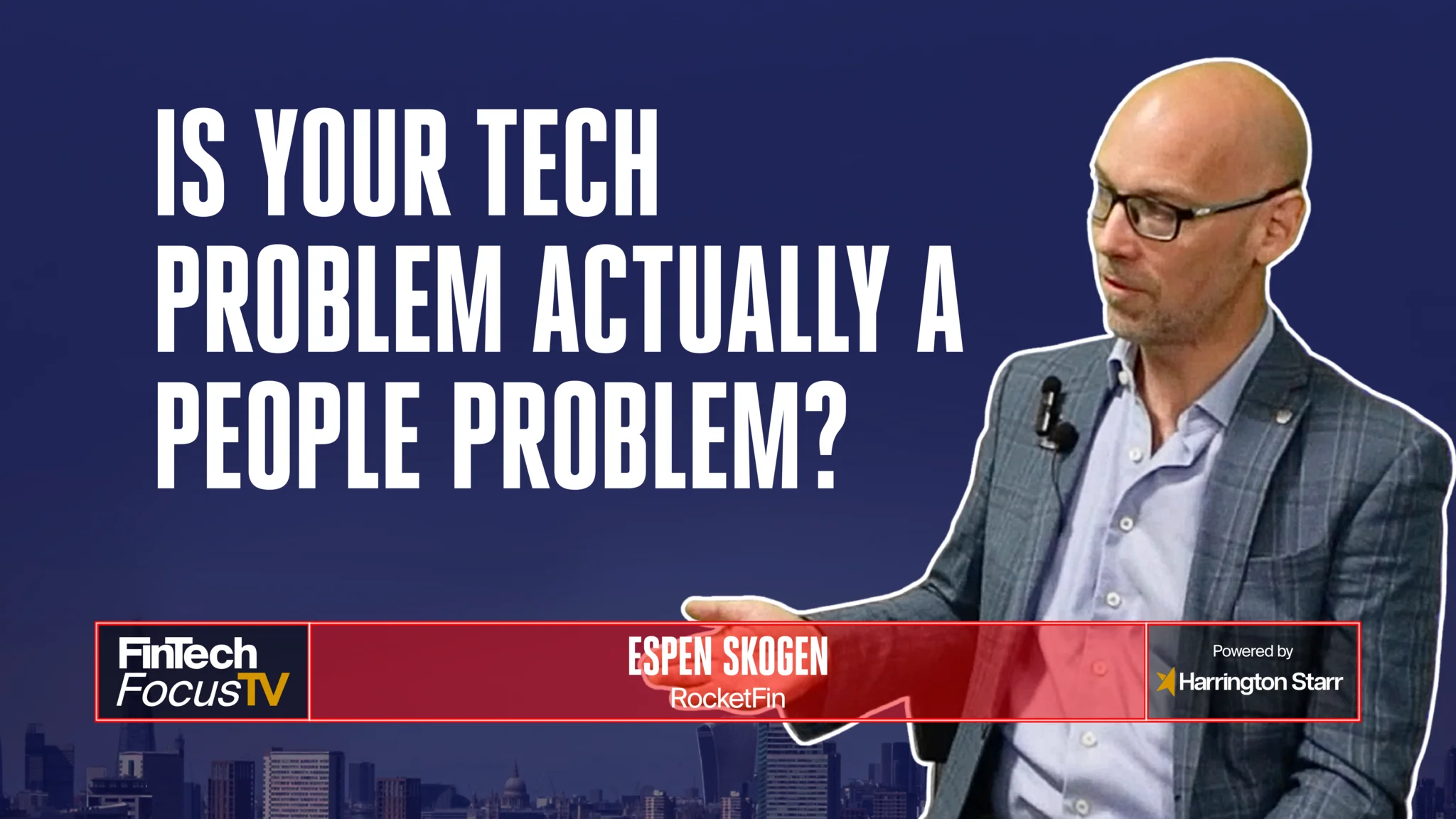
In this episode of FinTech Focus TV, Harrington Starr CEO Toby Babb is joined by Espen Skogen, CEO of RocketFin, for a conversation exploring the relationship between people, technology, AI and digital transformation across financial services.
Drawing on Espen's experience within major investment banks and his journey building RocketFin, the discussion explores why successful financial technology transformation needs to begin with the people using the technology and the outcomes they are trying to achieve. From the future of junior technology talent and AI-enabled software engineering to legacy systems, trading technology, consultancy and the value of smaller specialist teams, the episode asks an important question: is your tech problem actually a people problem?
Espen's career began within major investment banks, primarily working on single-dealer platforms. His experience included Morgan Stanley Matrix, HSBC, UBS and JPMorgan, where he ran Execute for several years before deciding there had to be a better way of approaching technology delivery.
That thinking ultimately contributed to the creation of RocketFin. The original hypothesis behind the company was relatively straightforward: small teams of highly competent people can outperform large teams of generalists.
After seven or eight years of testing that hypothesis, Espen explains that his thinking has developed further. A former colleague at JPMorgan used to tell him that if you think something is a technology problem, you are probably wrong. Instead, Espen argues that it is almost always a people problem: technology is the symptom, while people are the diagnosis.
That idea becomes one of the defining themes of the episode.
For financial services businesses investing heavily in digital transformation, financial technology and technology talent, it raises an important question. Are organisations solving the underlying business problem, or simply using new technology to address the symptoms?
The conversation moves into the structure of technology teams and whether bigger really means better.
Toby discusses the concept that one exceptional employee can create the productivity of several good employees, drawing comparisons with highly skilled specialist teams where quality and expertise matter more than simply increasing headcount.
Espen saw some of the problems associated with scale during his career within large financial institutions. As organisations become enormous, leaders can become increasingly removed from the individuals actually delivering the work. Employees risk becoming lines on a spreadsheet rather than people whose individual performance, knowledge and potential are clearly understood.
This can create situations where decisions are made evenly across teams despite enormous differences in the quality of those teams. A strong team could lose a capable employee while a weaker team elsewhere remains relatively untouched.
Smaller businesses operate differently. At RocketFin, which Espen says is approaching 30 employees, there is much greater visibility around individual performance. There is nowhere to hide, but there is also a clearer understanding of who needs development and where investment in people can make a difference.
For FinTech businesses thinking about technology hiring and building high-performing teams, the discussion highlights the importance of skills, capability and team structure rather than headcount alone.
No discussion about the future of financial technology talent is complete without artificial intelligence.
Espen raises a particularly important concern around junior technology professionals. AI can now perform some of the tasks that would traditionally have been given to junior employees, creating an obvious temptation for businesses to reduce hiring at entry level.
But what happens ten years from now if organisations stop developing junior talent today?
Toby introduces another perspective from a senior figure at a major consultancy: AI-enabled juniors could actually become considerably more valuable because technology allows them to achieve more at a lower cost than some middle-tier professionals.
Espen agrees that AI can be extraordinarily powerful, but adds an important distinction. In the hands of someone competent, it can be an extremely effective tool. The problem for junior developers is that they don't yet know what they don't know.
AI can produce an answer that appears convincing while still being wrong. Without enough experience to recognise those weaknesses, a junior software engineer could create something that initially looks effective but fails when placed under genuine pressure.
University provides foundations, but it cannot replace years spent developing real-world engineering experience, including experience building applications in demanding financial services environments.
Removing the junior layer therefore creates a longer-term talent problem. Without today's junior engineers gaining practical experience, businesses will not have tomorrow's senior engineers.
The productivity gains created by AI also differ according to experience.
Espen argues that a senior engineer using AI can become vastly more productive than they were previously. A junior engineer may benefit too, but the improvement is not necessarily equivalent because experience and judgement still matter.
This leads Toby and Espen towards an important distinction: AI should be viewed as an enabler and enhancer rather than simply a replacement for people.
For the FinTech recruitment market and businesses hiring software engineers, developers and financial technology professionals, this is an important part of the wider AI talent conversation. The question isn't only which tasks AI can perform. Organisations also need to consider which skills become more valuable when professionals have access to AI and how they continue developing the next generation of experienced technology talent.
The technology may change rapidly, but expertise, judgement and the ability to recognise what good looks like remain central to successful delivery.
The conversation then turns directly to one of Espen's most compelling descriptions of digital transformation: a "people problem wearing a tech mask."
Financial institutions can have decades of processes, systems and institutional knowledge embedded within their organisations. The people who originally created those systems may have left years ago, leaving today's teams working with technology without necessarily understanding every decision that led to its creation.
When a consultant or senior technology leader enters that environment, it can be easy to look at legacy technology and decide it needs replacing.
But replacing an old system with a modern one doesn't automatically constitute transformation.
If the workflow remains exactly the same and people continue operating in exactly the same way, Espen argues that the business can end up with effectively the same process presented through a more attractive user interface.
True financial services digital transformation therefore requires a deeper understanding of why people work the way they do.
Rather than assuming previous decisions were wrong, organisations need to approach transformation with empathy. There was often a reason a process developed in a particular way. Understanding that journey allows technology teams to separate what is genuinely necessary from what simply exists because "it's the way we've always done it."
Espen recalls working on major trading platform projects and sitting down directly with traders to understand their working day.
A trader might explain that they book a trade in one system, enter information somewhere else, move into Bloomberg and then use another tool or script to complete another part of the process.
The important question isn't simply what buttons they press. It is why they are pressing them.
By repeatedly asking why, technology teams can eventually reach the real objective behind a workflow. The trader may ultimately be trying to manage risk, ensure the back office receives the correct information or make sure a trade can settle successfully.
Once the objective is understood, the technology question changes completely.
Instead of asking how to replicate an existing process using newer technology, teams can ask what the best possible way of achieving the desired outcome actually looks like.
Sometimes the answer could be an entirely different process.
Espen gives the example of an "export to Excel" button as a potential warning sign. If users repeatedly need to take information out of one system and move it elsewhere to complete their work, there is probably something missing from the original workflow.
Understanding those behaviours is almost like archaeology: technology teams have to uncover why processes exist before deciding how they should be redesigned.
RocketFin has developed its approach around what Espen describes as "workspace engineering."
The idea starts with the workspace in front of an individual, such as a trader, and examines how that person actually performs their role. If someone constantly moves between multiple systems or repeatedly copies information from one platform into another, there is a strong chance the workflow is broken.
The answer isn't necessarily replacing every piece of technology.
Instead, integration can allow existing systems to work together more effectively. Espen explains that AI is also making it possible to create some of these integrations much faster, helping businesses build cohesive workspaces around users.
The principle is to begin with the customer experience and work backwards.
Starting with the technology itself, regardless of how sophisticated that technology might be, risks solving the wrong problem. Starting with what a person is trying to accomplish creates a much stronger foundation for effective financial technology.
This becomes particularly relevant across trading technology, where firms may operate numerous platforms, data sources and specialist systems that need to function together without creating increasingly complicated workflows.
AI isn't only transforming technology delivery. It is also challenging the traditional economics of consultancy.
Espen admits that the initial reaction from a consultancy perspective can be uncomfortable. If AI dramatically accelerates technology work, it can appear to threaten a model built around teams of people delivering projects over extended periods.
But he argues that clients were never really paying for people to type.
They were paying for judgement.
The value lies in understanding what good looks like, asking the right questions and taking an idea from concept through to working enterprise software.
AI can accelerate the manual work, but it does not eliminate the need for that judgement.
This changes how consultancy value can be commercialised. Traditional time-and-materials models are closely linked to utilisation and day rates. If AI allows considerably more work to be completed with fewer people and in less time, those models become harder to justify.
Instead, Espen believes consultancies increasingly need to put a value on their judgement and the outcome they can create.
Espen illustrates the scale of this change with a recent proposal RocketFin had made to a large asset management organisation.
The original project was expected to be a multi-year engagement involving a team of around 10 to 15 people and costing approximately £1 million per year. After the project became caught in an approval process, RocketFin revisited the opportunity through the lens of what was now possible with AI.
The revised proposal came to approximately £200,000 while targeting the same outcome.
The judgement and expertise facing the client remained. What changed was the amount of manual overhead required to deliver the work.
For financial services technology teams, this demonstrates why AI adoption isn't simply about replacing roles. It can fundamentally change the economics of technology transformation, allowing smaller teams to deliver outcomes that previously required far greater resources.
Espen describes this as a democratisation of the ability to transform.
Smaller organisations can increasingly access capabilities that historically required enormous technology budgets and teams, potentially creating a more level playing field across financial services.
Being smaller can also create advantages around speed.
Espen compares a huge organisation to the Titanic: turning it takes time. Smaller businesses can be considerably more nimble, allowing them to respond to technological change and new opportunities faster.
But large financial institutions have repeatedly demonstrated their ability to adopt new movements. Toby reflects on the early FinTech narrative, when challenger companies were supposedly coming to replace the banks. Instead, many banks invested in FinTech companies, created innovation labs and became part of the wider FinTech ecosystem.
Espen argues, however, that adoption can sometimes be superficial.
He recalls the period when Agile transformation became a major priority for large organisations. At one bank, his supposedly Agile team was told that an entire sprint would be dedicated to documenting what they would do in the following sprint.
The organisation had adopted Agile terminology, but its underlying need for long-term plans and documentation hadn't disappeared.
A similar risk exists with wider FinTech transformation. Businesses can introduce new apps, technologies and terminology while the organisation underneath continues working in fundamentally the same way.
Real transformation therefore requires more than a technological veneer. It requires organisations to reconsider how they operate.
Towards the end of the episode, Toby and Espen discuss RocketFin's own evolution.
The company has moved through several stages, from being willing to tackle a broad range of projects in its earliest days, through a period with a stronger focus on risk and quantitative expertise, towards greater specialisation around portfolio management and trading.
Now AI is opening another potential chapter.
Espen explains that RocketFin isn't becoming a product company yet, but could be moving towards something resembling that model. Strategic partnerships and developments across the buy side and sell side have encouraged the team to consider whether solutions they can create for clients could eventually become something more scalable.
The trading, execution management and order management markets provide an interesting opportunity. Espen points to the significant cost and complexity associated with some established platforms and asks whether there could be a better way.
That brings the conversation full circle.
RocketFin began with the belief that there had to be a better way of delivering technology. Years later, AI is increasing the ability of smaller, specialist teams to rethink established approaches again.
The biggest takeaway from this episode of FinTech Focus TV is that technology alone doesn't create transformation.
AI can dramatically improve productivity. Modern financial technology can connect previously fragmented systems. Smaller teams can potentially deliver outcomes that once required far greater headcount and investment. But none of these developments remove the importance of people.
Businesses still need experienced technology professionals who understand what good looks like. Junior talent still needs opportunities to develop the experience required to become tomorrow's senior engineers. Consultants still need the judgement to ask questions others haven't considered. And financial institutions still need to understand what their people are actually trying to achieve before deciding which technology should be built.
For the FinTech recruitment market, this creates an increasingly interesting talent landscape. As AI changes software engineering, trading technology, consultancy and digital transformation, the value of financial technology professionals will increasingly be defined not only by what they can produce manually, but by their judgement, domain expertise, problem-solving ability and capacity to use new technology effectively.
The tools are becoming more powerful. The teams delivering transformation may become smaller. The economics of technology projects may change dramatically.
But as Espen's argument throughout the conversation makes clear, the starting point remains human.