Building Resilient Careers in Financial Technology
26 March, 2026


In this special episode of FinTech’s DEI Discussions, Nadia introduces listeners to the #TurnToTech series, a 12-part podcast collaboration between FinTech’s DEI Discussions, the City of London Corporation, and the Women Pivoting to Digital Taskforce. The mission of the series is simple yet transformative: to demystify digital careers, highlight the lived experiences of women who have transitioned into technology roles, and provide practical guidance for those considering the leap. At its core, the initiative exists to address the ongoing underrepresentation of women in digital and FinTech roles, and to equip them with the confidence, skills, and support structures they need to succeed and thrive.
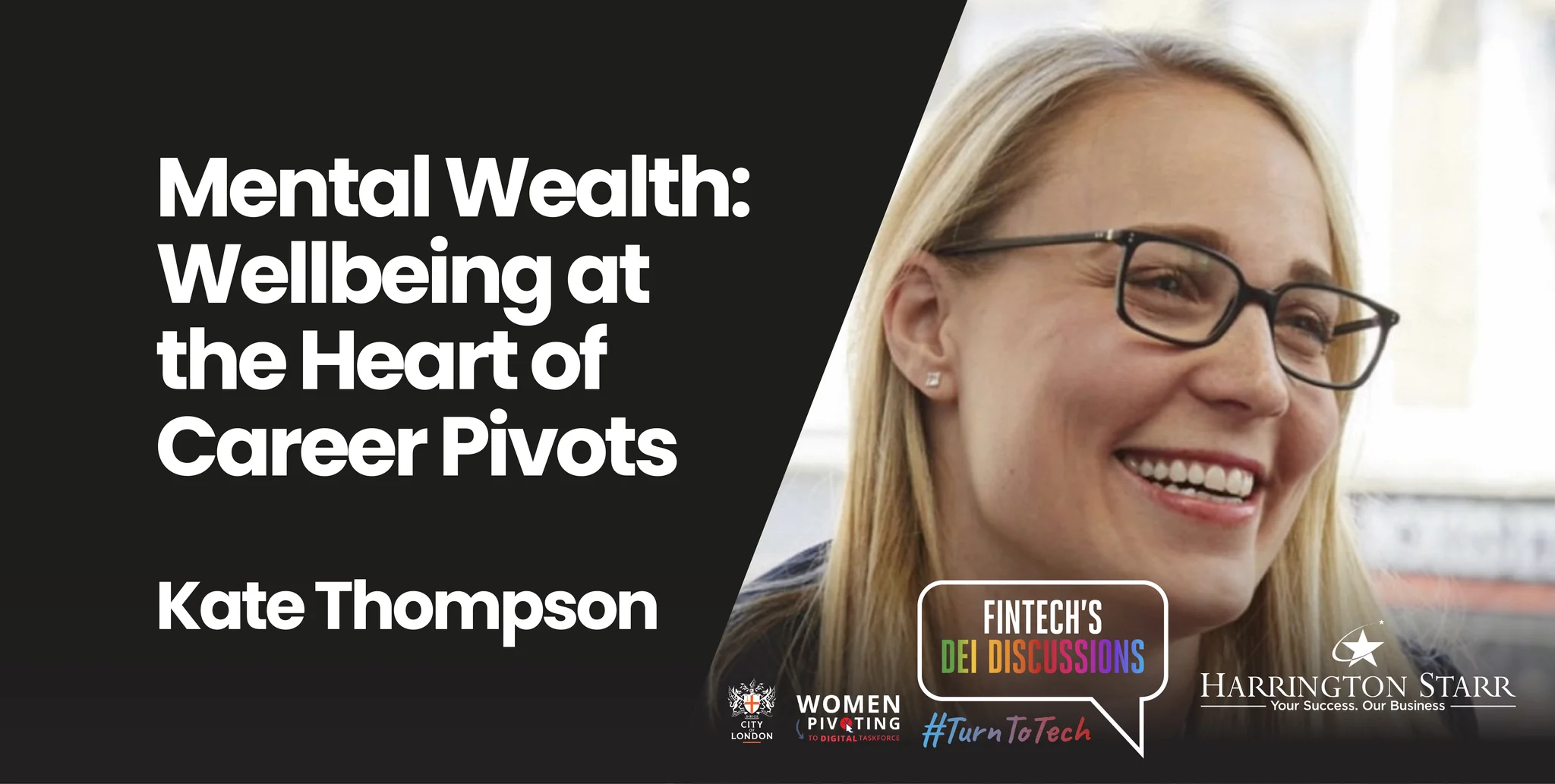
Throughout this episode, Nadia speaks with Kate Thompson, board member of the Women Pivoting to Digital Taskforce, behavioural scientist, lecturer, advisor and entrepreneur. Kate’s insights offer a compelling blend of academic grounding, commercial experience, and lived leadership, making this one of the most powerful conversations in the #TurnToTech series. Her unique perspective spans the science of happiness, transformational business strategy, organisational culture, leadership capability, and the journey of scaling a purpose-driven organisation from start-up to multinational acquisition. Kate’s career has been shaped by her commitment to wellbeing at work, to supporting women and underrepresented groups, and to building environments where individuals can thrive. This makes her an exceptional contributor to discussions centred on FinTech careers, digital transformation talent, and the future of inclusion within the industry.
When Nadia invites Kate to expand on her passion for mental wellbeing, happiness and work, Kate begins with the deeply personal experiences that first shaped her academic and professional focus. Growing up with a father who lived with bipolar disorder, she learned early the realities of mental health, the importance of supportive environments, and the effect that emotional wellbeing has on the quality of one’s life. That early exposure sparked a lifelong interest in the science of happiness and led her to behavioural science studies at the London School of Economics, where she focused on wellbeing, happiness, and the factors that shape women’s experiences at work.
This foundational understanding has guided her research, teaching, and leadership roles. As Kate explains to Nadia, work sits right at the centre of human wellbeing. The fact that people spend roughly a third of their lives at work, paired with the reality that around a third of individuals report being unhappy while there, reveals a stark imbalance. Work is both a major influence on wellbeing and, in many cases, a significant contributor to unhappiness. Kate argues that employees have a right to be happy at work, and leaders have a responsibility to understand this not only as a moral imperative, but as a commercial one.
She reinforces this point with robust research, including evidence from Oxford’s Wellbeing Research Centre and Indeed, where data from nearly 1,800 US companies and 25 million employee surveys demonstrated a direct correlation between high wellbeing and stronger financial performance. Companies that score highly in employee happiness outperform their peers across measures such as firm value, profitability, and return on assets. Happier workforces are more productive, more loyal, and consistently deliver better commercial results. For FinTech businesses navigating complex digital transformation, talent shortages, and competitive markets, the implications are undeniable: investing in wellbeing is investing in organisational performance.
Nadia shifts the conversation to the central purpose of the #TurnToTech series: supporting women who are considering a move into digital roles. Whether they are seeking progression, more meaningful work, or simply a more sustainable career path, the leap into technology requires confidence, clarity, and support. Kate responds by offering three core principles that are useful not only for women pivoting into digital careers, but for anyone preparing for major career change.
The first principle is to start with your strengths. Kate explains that strengths are often underexamined in traditional work cultures, where feedback typically focuses on development areas rather than what people naturally do well. She encourages individuals to seek specific, contextualised feedback so they can build an accurate “evidence bank” of strengths – a concept that resonates strongly with Nadia, who shares that she once kept a dedicated email folder for this exact purpose. Strengths become a grounding source of confidence when navigating new challenges, especially early in a digital career pivot when uncertainty is inevitable.
The second principle is to focus on how you show up, not just what you know. While skills are important, Kate highlights that mindset, energy, curiosity and emotional presence often have equal or greater impact. She brings in research around Flow State, emphasising that wellbeing – physical, emotional, mental and social – fuels creativity, productivity and the ability to learn. For women entering digital roles for the first time, cultivating the conditions that support their own energy and confidence becomes essential.
Her third principle is to avoid treating the career pivot like climbing Everest. Instead, she recommends breaking the journey into smaller, achievable summits. The goal is not to become a digital leader overnight but to identify manageable next steps, such as completing a course, taking on an initial project, or building early exposure to technical tools. Crucially, she urges listeners to pause at each milestone, reflect on progress and celebrate small wins. This pattern of action, reflection and re-setting is far more sustainable than striving solely toward a distant three-year plan.
For FinTech recruitment specialists like Harrington Starr, who support professionals entering new digital pathways, Kate’s advice reinforces the importance of confidence building, capability development, and access to structured support. Understanding these behavioural patterns helps hiring managers and leaders design environments where pivoting talent can thrive – which ultimately increases retention and drives stronger performance across digital transformation teams.
The business case for supporting women into digital and FinTech careers is clear, multidimensional and backed by decades of research. Kate explains that diversity fuels innovation and performance, especially when organisations create environments where individuals feel they belong and can contribute fully. She references research indicating that companies in the top quartile for gender diversity are 25% more likely to outperform their peers financially, a finding widely substantiated across industries.
Yet, the diversity case is only one part of the argument. The wellbeing case is equally compelling. With extensive research demonstrating the correlation between happiness and productivity, organisations that prioritise wellbeing gain a competitive advantage. Kate cites a study that examined hypothetical stock portfolios built from the happiest companies in the dataset. Remarkably, $1,000 invested in those companies would grow to $1,600 within four years, significantly outperforming major indices such as the S&P 500. Leaders, she argues, must begin to take wellbeing as seriously as financial performance because the two are intertwined.
For FinTech employers, particularly those scaling digital platforms, adapting to AI, or transforming legacy systems – the case for inclusive hiring and supportive career pathways is strong. By welcoming women into digital roles and providing the conditions for them to succeed, organisations increase innovation, strengthen culture, reduce attrition and build more resilient teams. Nadia reinforces this point by highlighting the significance of creating happiness at work and how it unlocks potential that otherwise remains dormant.
When Nadia asks what businesses can practically do to support women entering digital careers, Kate offers a nuanced perspective grounded in behavioural science. She distinguishes between direct interventions, such as wellbeing apps, gym memberships or workshops, and indirect interventions, which focus on how work itself is designed. The latter, she emphasises, have a far stronger impact on wellbeing and overall employee experience.
Kate outlines six drivers of wellbeing at work: development and security, relationships and belonging, independence and flexibility, meaning and fulfilment, fair pay and benefits, and fundamental health and safety. For women pivoting into digital careers, three drivers play an especially critical role: security, flexibility and relational support.
Security is vital because anyone entering a new field, particularly women joining male-dominated digital teams, may experience feelings of precarity. Whether the confidence gap stems from being new to the field, working on contracts, or navigating unfamiliar environments, leaders can mitigate this by providing clearer communication, regular feedback and development opportunities. Kate cites research showing a strong correlation between low communication and high job insecurity, demonstrating that leaders can significantly influence how safe people feel simply through consistent, transparent communication.
Flexibility is equally important. While digital roles may offer autonomy and remote work, they also risk blurring boundaries, especially for women balancing multiple responsibilities. Leaders must understand individual needs and create structures that preserve both flexibility and recovery time.
Relationships form the final foundational driver. Entering a digital environment that wasn’t originally designed with women in mind can leave individuals feeling isolated. Kate explains that quality of relationships, not just frequency of interaction, determines belonging. Managers play a central role in shaping relational culture, and mentorship programmes have been shown to benefit both mentees and mentors. She encourages businesses to consider who sits within a woman's “relational orbit” – mentors, buddies, sponsors and peers, and whether that support system is strong enough to help her succeed.
Nadia connects strongly with this concept, describing it as scaffolding – the essential structure that holds individuals up while they learn. She emphasises that without scaffolding, businesses unintentionally set women up for failure. With it, they accelerate their success.
As the episode concludes, Nadia reflects on how powerful, research-led and practically actionable Kate’s advice is. The conversation unpacks the science of happiness, the commercial realities of wellbeing, the challenges and opportunities of digital career transitions, and the steps employers must take to support women entering technology. Kate’s insights highlight that the intersection of wellbeing, inclusion and digital transformation is not just a moral responsibility but a strategic imperative for FinTech businesses.
The #TurnToTech series exists to inspire women to explore digital careers, equip them with guidance, and illuminate the pathways available within the rapidly evolving FinTech ecosystem. For Harrington Starr, a global FinTech recruitment specialist, these conversations reinforce the industry’s collective responsibility to build accessible career routes, nurture diverse talent and elevate the women shaping the future of financial technology.