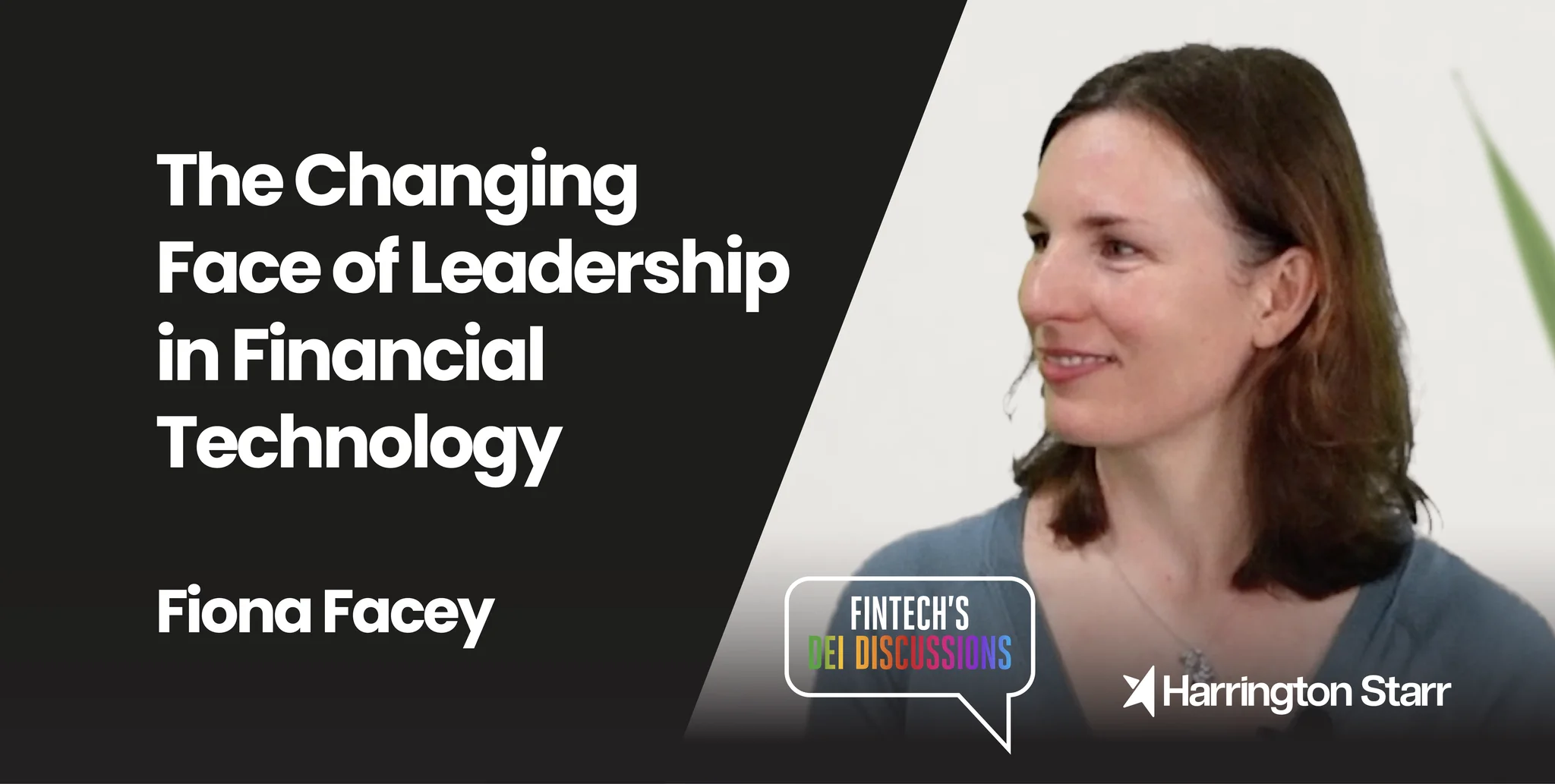
The Changing Face of Leadership in Financial Technology
The financial technology industry continues to evolve rapidly, driven by innovation, data, and changing expectations around leadership and culture. But alongside the transformation of technology itself, another shift is taking place: the expectations placed on leaders within financial services are changing.
In this episode of FinTech’s DEI Discussions, Nadia Edwards-Dashti sits down with Fiona Facey, Technology Business Manager at Scotiabank, to explore how leadership in financial technology is evolving, what inclusive leadership really looks like in practice, and how organisations can build stronger teams by embracing diverse perspectives.
Their conversation moves beyond theory to examine the lived experiences of working in financial technology, the importance of psychological safety in the workplace, and why leaders must actively create environments where different voices are heard.
For organisations across the financial services ecosystem, these conversations are increasingly relevant. As the demand for skilled professionals grows and competition for talent intensifies, FinTech recruitment strategies must consider culture, leadership, and inclusivity alongside technical capability.
Building a Career in Financial Technology | FinTech Talent and Career Growth
Fiona begins by reflecting on her own journey into financial services, which started nearly two decades ago. Interestingly, she notes that when she first entered the industry, she didn’t even know what an investment bank was.
Like many professionals in financial technology today, her career developed through exploration, learning, and a willingness to move between different areas of the organisation.
Over the course of her career, Fiona worked across a mix of “run the bank” and “change the bank” roles, primarily within operations. These roles gave her deep exposure to how financial institutions function at a fundamental level and allowed her to build expertise within specific product lines.
However, rather than remaining within a narrow specialism, Fiona deliberately chose to broaden her perspective.
At one stage in her career, she decided to pivot into a central Chief Operating Officer–type role within operations. This shift allowed her to gain visibility across multiple business lines and better understand how different functions within a financial institution interact.
For professionals working in financial technology today, this kind of career mobility is increasingly common. The industry is no longer characterised by rigid career ladders. Instead, careers in fintech often involve moving across functions, gaining exposure to technology, operations, and strategy along the way.
Transitioning into Technology Roles in Financial Services
One of the most defining moments in Fiona’s career came when she decided to transition into technology.
After having a child, she faced the dual challenge of navigating life as a working parent while continuing to grow professionally. Rather than stepping back from new opportunities, she chose to move into a technology-focused role.
This decision reflects a broader trend across the financial technology industry. As banks and fintech firms continue to invest heavily in digital transformation, the boundary between business and technology roles has become increasingly blurred.
Professionals who understand both the operational side of financial services and the technology infrastructure supporting it are becoming invaluable.
Fiona’s experience illustrates how career pivots into technology do not always require a traditional technical background. Instead, they often depend on curiosity, adaptability, and the ability to understand how technology supports business outcomes.
This is particularly relevant in today’s FinTech recruitment landscape, where organisations are looking for talent capable of bridging the gap between business strategy and technology delivery.
Inclusion and Leadership in FinTech Organisations
A major theme throughout the conversation is the importance of embedding inclusion within organisational culture rather than treating it as a standalone initiative.
Fiona explains that at Scotiabank, inclusion is embedded both as a value and as a behaviour within the organisation’s code of conduct.
One of the principles highlighted in the bank’s framework is the expectation that everyone should be treated fairly, equitably, and professionally. But beyond policy statements, Fiona emphasises that the real test of any inclusion initiative is whether it is brought to life in everyday workplace interactions.
This is where leadership plays a crucial role.
Policies alone cannot change culture. Instead, leaders must actively demonstrate inclusive behaviours, encourage diverse viewpoints, and create environments where employees feel comfortable contributing ideas.
In the context of financial technology, where teams often include professionals from different backgrounds, disciplines, and cultures, inclusive leadership is essential for innovation.
Diverse teams bring different ways of thinking, different experiences, and different problem-solving approaches. When leaders encourage these perspectives to be shared openly, organisations are more likely to arrive at better outcomes.
Psychological Safety and the Future of FinTech Leadership
Another topic Fiona highlights is the importance of psychological safety in the workplace.
She recalls her first week at Scotiabank, where she encountered training focused specifically on what psychological safety means within the organisation. This concept emphasises the importance of ensuring employees feel safe to express ideas, ask questions, and challenge assumptions without fear of negative consequences.
Psychological safety has become an increasingly important topic in leadership conversations across the financial technology sector.
In high-pressure environments such as banking and fintech, teams often face tight deadlines, complex regulatory requirements, and rapidly evolving technologies. In these conditions, employees must feel confident that they can raise concerns or propose new ideas without hesitation.
For leaders, fostering psychological safety means encouraging open dialogue and ensuring that every team member feels respected and valued.
When employees feel safe to speak up, organisations benefit from greater collaboration, stronger problem solving, and improved decision making.
Why Diverse Voices Improve Decision Making in Financial Technology
During the conversation, Fiona shares a particularly memorable perspective on team building and leadership.
Rather than assembling teams composed of individuals who think in the same way, she argues that effective leadership requires bringing together a variety of voices.
When teams consist of individuals with identical perspectives, organisations risk overlooking blind spots.
However, when leaders deliberately encourage diversity of thought, teams become more resilient and better equipped to navigate complex challenges.
In financial technology, where innovation often depends on creative problem solving, diversity of thought can be a significant competitive advantage.
Different experiences and viewpoints enable teams to approach problems from multiple angles, increasing the likelihood of identifying effective solutions.
This idea also has important implications for FinTech recruitment strategies. Hiring managers must look beyond traditional career paths and consider candidates who bring varied experiences and perspectives to the organisation.
From Policy to Practice: Making Inclusion Tangible
Throughout the conversation, Fiona stresses the importance of moving beyond “fluffy” language when discussing inclusion.
While many organisations publicly state their commitment to diversity and inclusion, the real question is how these values translate into everyday behaviour.
For Fiona, inclusion becomes tangible when leaders actively ensure that different voices are not only present in the room but also heard and considered during decision-making processes.
This means encouraging participation from individuals who may not typically speak first in meetings and ensuring that quieter voices are not overlooked.
It also means recognising that leadership involves listening as much as directing.
In financial technology organisations, where cross-functional collaboration is common, this approach can significantly improve the quality of decisions being made.
The Role of Leadership in Shaping FinTech Culture
The conversation between Fiona and Nadia ultimately highlights the evolving nature of leadership within financial services.
Traditional leadership models often emphasised authority and expertise. Today, however, effective leaders must also demonstrate empathy, openness, and the ability to bring together diverse perspectives.
This shift reflects broader changes taking place across the financial technology industry.
As fintech firms grow and established banks undergo digital transformation, the skills required for leadership are changing.
Technical expertise remains important, but leaders must also be capable of building inclusive teams, supporting professional development, and creating cultures where employees feel empowered to contribute.
For organisations seeking to attract and retain top talent, leadership culture is increasingly becoming a differentiating factor.
FinTech Recruitment and the Importance of Inclusive Leadership
From a FinTech recruitment perspective, conversations like this highlight the growing importance of culture and leadership in attracting top professionals.
Today’s candidates are not only evaluating salary and job responsibilities; they are also considering workplace culture, leadership style, and opportunities for growth.
Companies that demonstrate a genuine commitment to inclusion and professional development are often better positioned to attract high-performing individuals.
Recruitment firms working within the financial technology sector are seeing this shift firsthand. Clients increasingly seek candidates who can contribute to both technological innovation and cultural development.
Similarly, candidates are looking for organisations where they can build meaningful careers while feeling supported and valued.
The Future of Leadership in Financial Technology
As the financial technology industry continues to grow, leadership will play a critical role in shaping the future of the sector.
Organisations must adapt to rapid technological change while also addressing the evolving expectations of employees and customers.
The conversation between Fiona Facey and Nadia Edwards-Dashti highlights an important truth: leadership today is not simply about directing teams or delivering results.
It is about creating environments where people feel safe, valued, and empowered to contribute their ideas.
By encouraging diverse perspectives and fostering inclusive cultures, financial technology organisations can unlock new levels of innovation and performance.
For businesses across the fintech ecosystem, these insights are particularly relevant as they navigate the challenges of attracting and retaining talent in an increasingly competitive market.