AI, Mega Rounds & Fintech Venture Capital in 2026
11 March, 2026


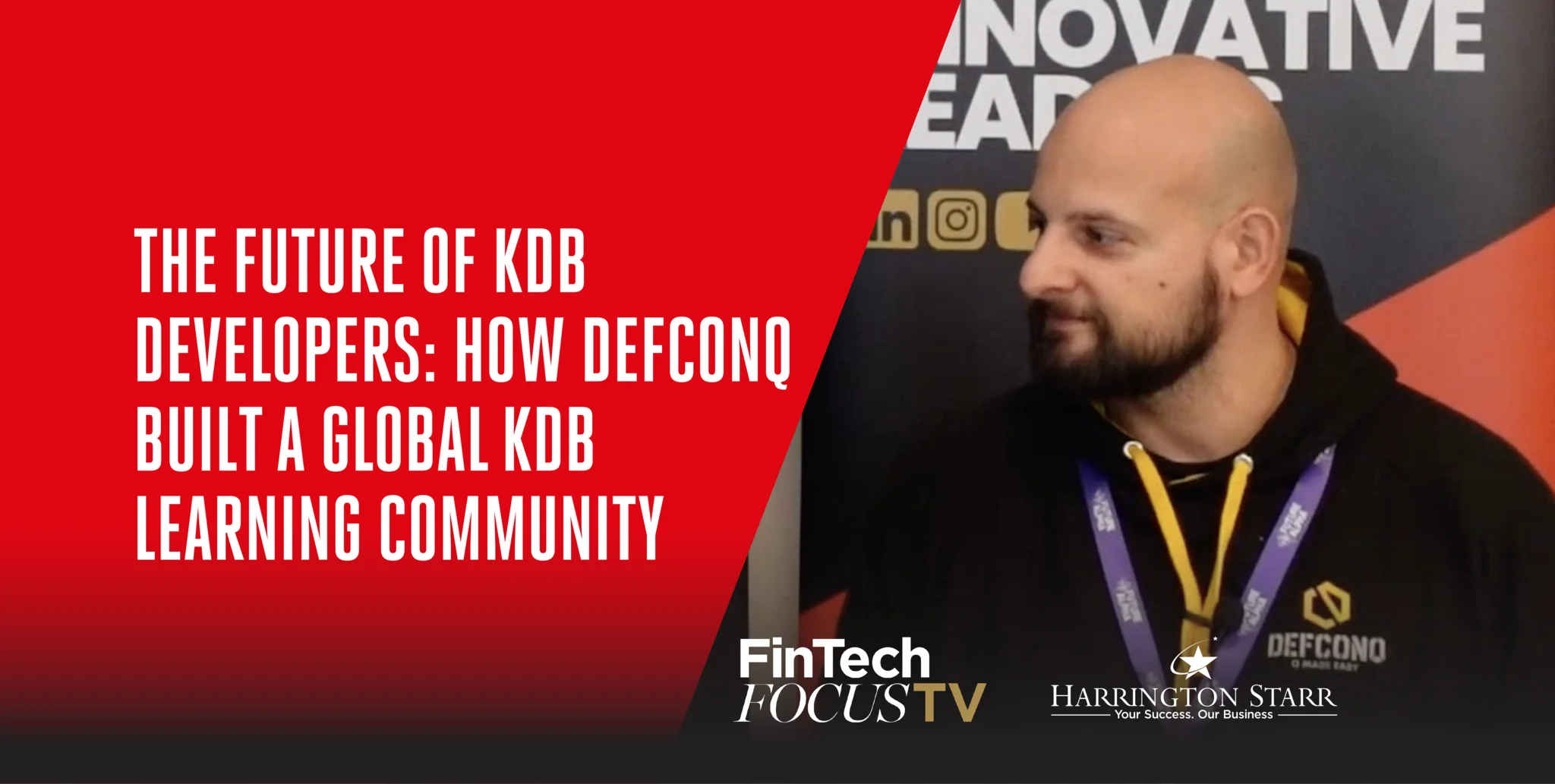
Recorded at Quant Strats London, this episode of FinTech Focus TV brings together Lucia and her guest, Alex Unterrainer, founder of DefconQ, KDB enthusiast, and passionate educator in the quantitative finance community. The conversation opens with a simple introduction, but quickly dives into the deeper motivation that led Alex to create what he now calls a “tech compass in a complex world.” The discussion is a rare and honest exploration of how technical talent, particularly in FinTech, discovers its path, builds resilience, and ultimately learns to make high-performance systems that work in real environments.
Alex begins by giving a snapshot of his workshop from the day prior: a full masterclass that walked attendees from raw data ingestion to visualisation in only 90 minutes. His goal was not just to demonstrate syntax or theory but to show how a working solution can be built. Participants saw live how to take data from a feed, stream it into a KDB Tick setup, and display it through Pulse, a framework that allows developers to generate elegant, efficient user interfaces rapidly. According to Alex, this practical demonstration was the most surprising moment for the audience. Seeing how much can be achieved with so little code was a breakthrough. Many expected that learning KDB would be slow, conceptual, or something they would only truly understand after being hired into an investment bank. Watching it in action, in real time, shifted their mindset. In FinTech recruitment terms, it is the same transformative moment that comes when a candidate realises they are capable of stepping into a high-performance environment.
As Lucia introduces DefconQ’s ethos, she notes that the blog describes itself as a way to turn “the daunting into the doable.” It is a community-driven platform built to lift the veil off KDB. The conversation quickly clarifies that Alex didn’t build DefconQ out of marketing ambition. He built it because his journey into the language was lonely, and in his words, “like being thrown into the cold water.” When he joined Citigroup’s KDB team after graduating from his tech scheme in 2015, there was little support or a structured learning pathway. The unofficial approach was simply being directed to “Q for Mortals” and being expected to endure until the language made sense. For many, this overwhelming beginning is exactly where their learning ends. Alex explains that if he had done ten push-ups every time he wanted to quit, he would be enormous by now. Instead, he persevered.
DefconQ, therefore, emerged from years of personal struggle. Two years ago, Alex made the decision to give back. He started posting breakdowns of KDB concepts in plain language, sharing tutorials, and offering practical examples that anyone could follow without needing exposure to confidential financial systems. It is not a pipeline of secret industry techniques; instead, it is a practical toolkit. Alex shows what can be done and allows readers to use those building blocks to build their own ideas. Speaking engagements followed, industry experts praised the work, and the community continued to grow. Today, Alex travels frequently to speak at conferences, including a recent trip to New York, always talking about KDB and its applications. The story is a reminder of why FinTech talent pipelines must be accessible. The best technologists are not always born from a consultancy funnel.
Lucia asks a question many quantitative finance leaders grapple with: if KDB is so valuable, why do so few people understand how to begin? The answer is structural. Traditionally, KDB developers come through two major consultancy firms, building their competence through proprietary client placements. These firms hire graduates, train them internally, then send them into investment banks and hedge funds. Knowledge is passed down behind closed doors. External learners never see the practical use cases; documentation is high-level, theoretical, and often written in isolation from how real KDB workloads function.
For FinTech employers, this model has consequences. The global market wants more KDB specialists than it has supply. Even as quantitative funds scale infrastructure and global exchanges generate larger real-time datasets, the bottleneck remains expertise. Alex notes that the official documentation isn’t designed for beginners who want to build something “real.” Because of the secretive nature of finance, examples rarely show full workflows. You may understand what a function does, but not how to actually connect it to a feed, structure, storage, or build a visualisation layer. People who want to break into the sector face a paradox: they can’t learn real-world KDB without being in the industry, and they can’t enter the industry without demonstrating skill.
That is why DefconQ’s tutorials are so popular. They demonstrate exactly how an individual can build a simplified working system. The aim is not to give away confidential code. It is to provide a blueprint, an understandable framework that empowers newcomers to think in KDB. It is the same philosophy Harrington Starr brings to FinTech recruitment: removing barriers, helping professionals see where they fit, and demystifying complex environments so they can flourish in them.
Lucia shifts the discussion to the role of practicality in quantitative development. For quants, mathematics and creativity are only as useful as their implementation. Alex explains that quants are “very hands-on.” They think deeply about models that generate alpha or revenue, but if those models cannot function in production, they are worthless. This is where KDB has a competitive edge. Its ability to handle massive time-series data volumes while allowing experimentation makes it ideal for financial environments. It provides a way to test ideas quickly and iterate with minimal overhead. In contrast to languages like Python, KDB allows practitioners to go straight from hypothesis to live prototype.
The connection to hiring is clear. FinTech employers today are not looking for theoretical specialists. They are seeking talent who can translate insight into operational systems. Whether you are a candidate breaking into quant environments or a business scaling your trading tech, execution is what matters. Alex demonstrates why engineers working in live environments must build intuition by doing, not simply reading. Watching his masterclass participants move from confusion to clarity as they produced a functional pipeline was a reminder: quant is not an academic discipline. It is an applied craft.
As Lucia and Alex explore DefconQ’s evolution, the tone becomes more personal. In many ways, it feels less like a business and more like a growing collective. Alex wants to expand it with tutorials, meetups, and continuous education. Community happy hours already run in London, Belfast, and New York. Engineers attend to share ideas, learn from each other, and contribute to the culture.
Alex attributes this mindset to sports. Growing up, he learned teamwork: winning together and losing together. Sharing knowledge and upskilling the collective makes everyone stronger. In quant environments, this principle may feel unconventional because the industry has been shaped by strict secrecy and competitive advantage. But Alex sees mutual benefit. If more people are trained in KDB, opportunities expand. Businesses can build better systems. Job prospects increase. The ecosystem becomes richer for everyone involved.
He also believes strongly that KDB deserves wider adoption beyond finance. Data generation grows continuously; every device, wearable, or system logs activity and telemetry. Large data ecosystems are no longer exclusive to high-frequency trading desks. The more industries adopt KDB, the more talent will naturally migrate toward it. And that trend feeds back into career advancement, innovation, and the kinds of cross-pollinated ideas that make communities meaningful.
In FinTech recruitment terms, Alex is articulating a fundamental shift: expertise is no longer gatekept by institutions. It is democratised by communities. As new developers enter the market with real capabilities, whether through a blog, a workshop, or a self-directed project, they reshape the future of hiring. They expand what financial institutions consider talent. They reduce the friction that historically hindered junior technologists from stepping into quantitative roles.
It is clear that Alex genuinely enjoys teaching. He speaks about the emotional reward of receiving messages from strangers thanking him for his work. For someone whose own learning period was marked by frustration and uncertainty, that response matters. The gratitude validates not just the blog, but the entire mission of DefconQ. It shows that people outside the consultancy pipeline are now finding a place to begin.
Lucia observes that the community he has built already gives back to him. Alex agrees. He emphasises that teaching is a two-way exchange. While he helps others break into KDB, he also learns from them. Someone who reads his tutorial may later show him something he “hasn’t thought about yet.” This mindset, humility, curiosity, and reciprocity is not only refreshing but increasingly necessary in a competitive hiring market. Innovation emerges when talent has space to contribute.
As the episode nears its conclusion, Lucia asks Alex to share one piece of advice for anyone who missed the workshop but wants to begin mastering KDB without feeling overwhelmed. His answer is simple: read his blog. Everything is there: tutorials, walkthroughs, examples, and explanations designed to break down KDB in a way newcomers can digest. He encourages listeners to subscribe to his newsletter, which will remain free, providing consistent updates every two weeks. He also invites them to connect with him on LinkedIn, noting that he shares content frequently and encourages interaction. And finally, he directs them to the DefconQ site, devcompute.tech, where the learning journey begins.
In this moment, Alex reframes onboarding. Rather than suggesting people start with documentation or proprietary guides, he offers a human-driven pathway. Learn from example. Learn by making. Learn by participating in the community. In FinTech recruitment terms, it is the difference between screening for pedigree and screening for capability. The sector benefits most when knowledge is accessible and when motivated individuals have room to grow.
This episode of FinTech Focus TV highlights something often overlooked in quantitative finance. Technical excellence is not born solely from elite institutions or pre-structured graduate programmes. It grows in unexpected places when people are given access and encouragement. Alex’s journey demonstrates how professional success in FinTech is not linear. It is built through persistence, experimentation, and a willingness to share knowledge even when it feels risky.
At a macro level, this insight should matter to every FinTech business. The industry is hungry for KDB talent, data engineers, and quant developers who can drive performance at scale. The most strategic hiring partners, including recruitment firms like Harrington Starr, understand that talent today is shaped not just by CVs, but by communities of practice. Projects like DefconQ act as accelerators. They create new entry points, empower self-directed learners, and ultimately expand the candidate pool that powers trading desks, investment banks, and high-frequency firms.
Lucia and Alex close the episode on a positive note. For those who want to grow, there is a pathway. It is not effortless, but it is approachable. Mastering KDB is no longer reserved for insiders; it is something anyone can learn if they are willing to put in time, follow clear steps, and immerse themselves in a community that believes in shared progress.