Building Resilient Careers in Financial Technology
26 March, 2026

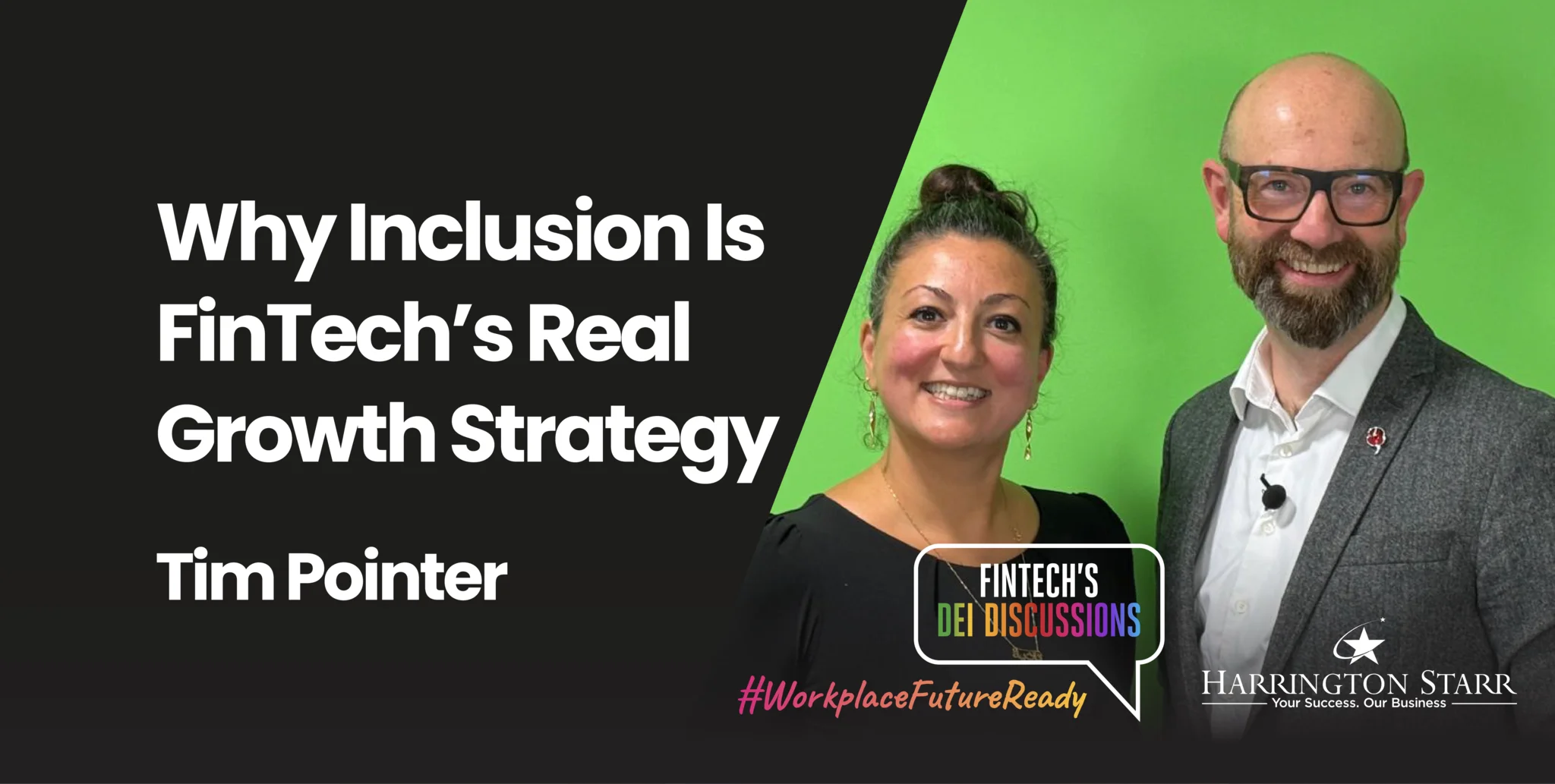
In this episode of FinTech’s DEI Discussions, hosted by Nadia, the conversation explores what it truly means to build organisations that are ready for the future of work. The featured guest, Tim Pointer, Portfolio Chief People Officer & Operating Partner at Three Hills, brings over 30 years of experience in people leadership, organisational development, transformation, and scaling. His insights align deeply with the realities of FinTech recruitment, where building high-performing, sustainable teams is crucial for long-term success.
The discussion opens with Three Hills’ mission: a private equity firm with more than 11 years of track record, backing entrepreneurial executives and ambitious leaders. Their role is to provide flexible capital to support business growth across multiple sectors, enabling their portfolio companies to expand into new geographies, diversify products and services, and pursue mergers and acquisitions. For Harrington Starr’s audience of FinTech leaders and hiring managers, this mirrors the challenges many scale-ups face when balancing people strategy, technical delivery, and rapid expansion.
Tim sits within Three Hills’ value-creation team, using decades of experience in human resources, people & culture, and organisational strategy to guide leadership teams through complex periods of transformation. Three Hills commitment to people, purpose, and planet is a running theme throughout the episode. This lens of purposeful growth resonates strongly with the FinTech world, where talent acquisition, retention, and culture-building have become mission-critical areas of focus.
A central theme of the episode is the idea of scaling from a future perspective. Tim explains that when an organisation is preparing to grow, whether from 160 people to 500 or through strategic market expansion, leaders must begin by envisioning what the business will look like at the end of the investment period. This is highly relevant for FinTech recruitment, where companies often attempt to scale in real time without fully considering the long-term people implications.
Tim describes a transformation model in which the future organisational design becomes the blueprint for today’s decisions. Leaders must identify the structural, technological, capability, and cultural requirements needed to thrive years ahead, and then map backwards to understand the steps required to arrive there.
For FinTech companies competing for top talent across engineering, product management, data, risk, commercial, and operational roles, this approach is essential. Many growing FinTechs prioritise revenue expansion without building the internal scaffolding that enables teams to succeed sustainably. Tim’s message is clear: successful scaling is a people challenge, and the companies that thrive are those that invest early in leadership capability, design rigorous systems, and build environments where talent can evolve over long periods of change.
Three Hills’ value-creation team partners with portfolio businesses to ensure they have the right capabilities, technology, and organisational design to navigate supercharged periods of growth. For FinTech leaders, this translates directly into intentional hiring, thoughtful workforce planning, and clear alignment between ambition and execution.
One of the most compelling insights Tim shares is his framework for scaling talent: Build, Buy, Borrow, and Bot. This model, though industry-agnostic, is particularly crucial for organisations in FinTech, where the competition for niche skills is intense and the pace of innovation continues to accelerate.
According to Tim, businesses looking to scale must first determine what they need to build internally. This refers to developing existing employees, nurturing high-potential individuals, and equipping them with the skills required for future roles. FinTech recruitment partners like Harrington Starr frequently see companies lose top talent due to a lack of development pathways, making proactive upskilling a competitive advantage.
The second lever is buying talent, bringing in individuals with the technical expertise, market relationships, or strategic experience needed for the next stage of growth. In FinTech, this often means hiring specialists across software engineering, data science, cyber security, commercial leadership, regulatory technology, or payments product roles. These hires often act as catalysts, unlocking capabilities that would otherwise take years to build.
The third lever, borrowing, acknowledges that some capabilities are best sourced externally rather than built in-house. This includes partnering with vendors, using contract specialists, and leveraging external advisors. FinTech companies often borrow technical expertise during major platform migrations, cybersecurity upgrades, or regulatory reporting transitions, reflecting Tim’s advice that no organisation needs to “own” every skill internally.
Finally, botting refers to the relationship between people and technology. In the FinTech sector, where automation, AI, and digital operational transformation are rapidly redefining job functions, botting is not simply a cost-saving measure, but a strategy to build scalable systems that enable people to operate at their best. Automation supports accuracy, consistency, and capacity, allowing teams to focus on high-value work.
This holistic view of talent strategy mirrors what Harrington Starr hears from FinTech clients: leaders must understand not only who to hire, but when, why, and how to combine human capability with technology to create enduring value.
As the conversation progresses, Nadia shifts the focus toward inclusion, a constant throughline in FinTech’s DEI Discussions. She highlights that Tim has been voted the “most influential HR practitioner in the UK” by HR Magazine readers, recognising his commitment to improving workplaces and championing inclusive leadership. The episode makes clear that diversity, equity, inclusion, and belonging (DEIB) are not side initiatives; they are fundamental components of organisational strategy.
Tim asserts that DEIB must never sit solely within HR. Instead, every function, commercial, procurement, product, marketing, technology, and operations must carry ownership for creating inclusive environments. When organisations see inclusion as a business-wide commitment, they make smarter decisions, design better products, and create workplaces where people want to stay.
To illustrate this, Tim references the book Invisible Women by Caroline Criado Perez, which demonstrates the consequences of designing products and systems without representative voices. Seatbelts designed for men put women at greater risk in collisions. High-heeled shoes designed by teams of men may look aesthetically pleasing but fail to consider the experience of those who wear them. These examples show how lack of diversity in decision-making leads to flawed outcomes.
This message is highly relevant to FinTech, where product teams design platforms for global, diverse populations. FinTech recruitment strategies must therefore focus not only on technical capability, but also on building teams that deeply understand user communities. Without inclusion in design, businesses cannot build scalable, equitable financial products.
Throughout the episode, Tim continually emphasises purpose as the anchor of organisational success. Whether he examines scaling strategies or DEI commitments, purpose underpins every decision. He explains that an organisation must align its people, behaviours, and decision-making processes with its mission.
He shares an example from the National Trust, where leaders focused deeply on ensuring that their mission, “for the country, for everyone,” was reflected in every aspect of their visitor experience and storytelling. They thought intentionally about how individuals with Alzheimer’s navigated National Trust properties and revisited places they had cherished for years. By centring humanity and empathy, they improved experiences for every visitor.
This philosophy is directly transferable to FinTech hiring and culture-building. FinTech companies that lead with purpose attract individuals who want to contribute to meaningful change, whether that is through financial inclusion, digital transformation, or reimagining legacy financial systems. For Harrington Starr’s recruitment audience, the takeaway is clear: purpose-driven companies consistently outperform because employees feel connected to something larger than themselves.
A recurring insight from Tim is that during periods of intense organisational change, retaining people becomes more difficult, and more essential. When employees feel overwhelmed, disconnected, or uncertain about the future, they are likely to disengage or leave. This leads to the loss of corporate memory, client relationships, and irreplaceable contextual knowledge.
FinTech organisations undergoing rapid scaling, regulatory change, or technological transformation must therefore create environments where people feel valued and supported. This includes transparent communication, clear expectations, opportunities for progression, and recognition of performance. Companies cannot scale sustainably if people are not equipped, and inspired, to take the journey with them.
For FinTech recruitment professionals, this underscores the importance of helping clients not only hire exceptional talent but also retain it. Culture, leadership, communication, and clarity all influence whether individuals choose to stay for the long term.
Toward the end of the episode, Tim shares details about his own podcast, Powered by People, produced by Three Hills. The series interviews leaders across sectors who have led large-scale transformation, from hospitality groups and global tech brands to major charities and multinational organisations.
Examples include:
These stories reinforce the idea that transformation cannot occur without people-centred leadership. Whether scaling hospitality, technology, or financial services, businesses succeed when they invest in culture, capability, and community.
For FinTech leaders, these insights broaden the perspective: talent strategy is not industry-specific. It is universal.
As the episode concludes, Nadia asks Tim what more organisations can do to build inclusive, future-ready workplaces. His answer is simple, powerful, and relevant to every FinTech employer: be intentional. Choose where you want to make a difference. Align actions with purpose. Include the voices of communities you serve. And ensure that every function, not just HR, owns the responsibility of building an inclusive organisation.
Tim reminds listeners that scaling is not just about systems or processes; it is about people. To prepare for tomorrow, leaders must invest in the human side of transformation today.
For FinTech recruitment, this message is essential. The companies that attract and retain the best talent are those that put people first, embed inclusion into every decision, and design workplaces where individuals can thrive through constant change.
This episode of FinTech’s DEI Discussions is a powerful reminder that the future of work in FinTech will be shaped not just by innovation, automation, or investment, but by the leaders who choose to walk the talk on inclusion.