FIX Protocol Should be the Standard
23 November, 2026


The US derivatives market is entering an interesting period of innovation. Products that gained traction in offshore cryptocurrency markets are attracting attention from regulated financial institutions, while exchanges and trading technology businesses are reconsidering how investors access markets, manage leverage and deploy capital.
At the centre of this discussion are perpetual futures, derivatives contracts that allow traders to maintain positions without a fixed expiry date.
For US capital markets, the implications extend beyond introducing another financial instrument. They raise questions about market infrastructure, regulatory oversight, collateral management and the technology required to support new trading models.
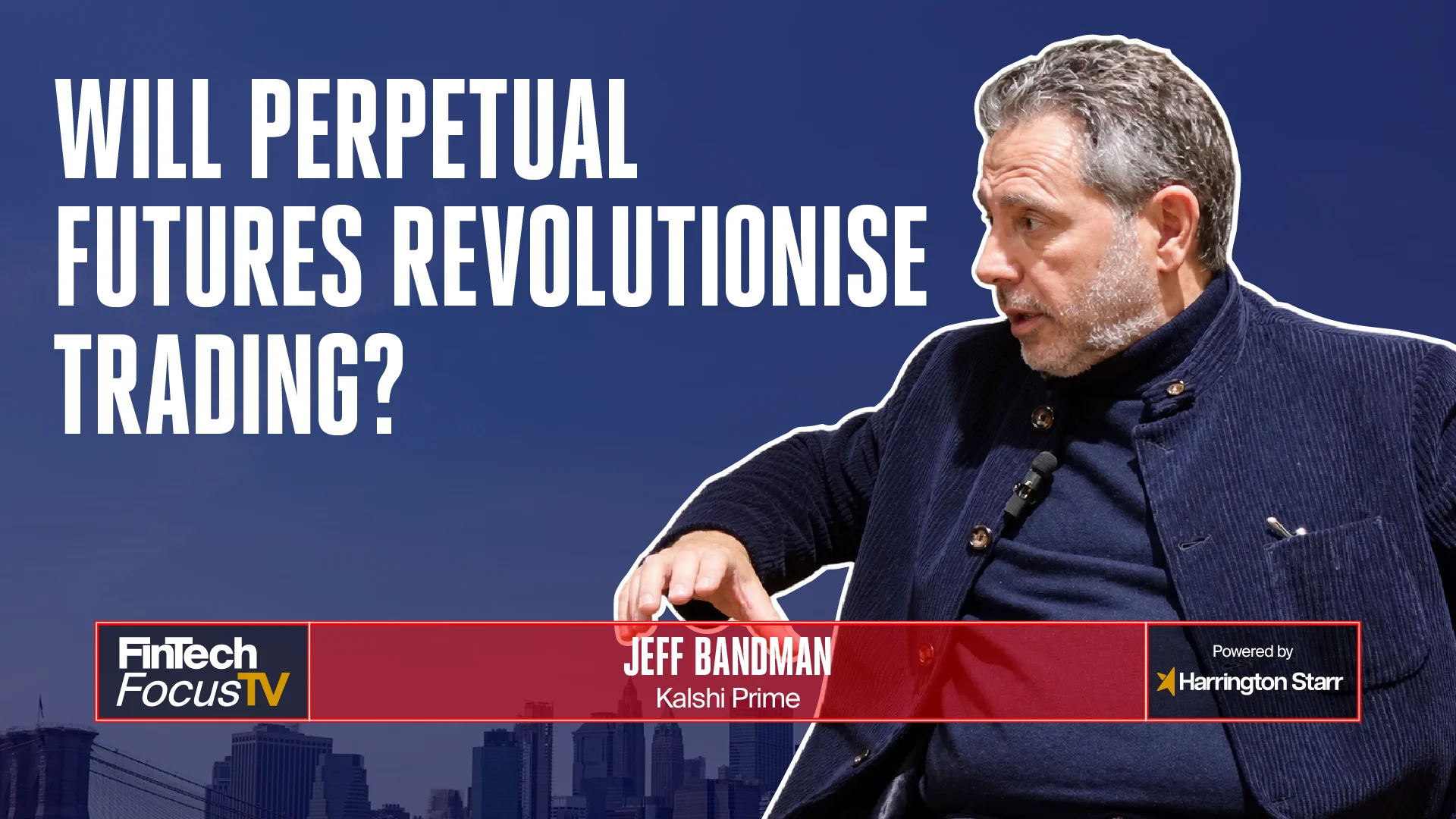
In this episode of FinTech Focus TV, Toby Babb speaks with Jeff Bandman, CEO of Kalshi Prime, in New York City. Their conversation examines how Kalshi secured regulatory approval, why perpetual futures could become increasingly relevant to US investors, and what innovation in futures market infrastructure means for financial institutions.
Perpetual futures are derivatives contracts that provide exposure to an underlying asset without a predetermined expiration date.
Unlike traditional futures, which expire on specified dates and may require traders to roll positions into subsequent contracts, perpetual futures can remain open subject to margin requirements and other trading conditions.
The product became particularly prominent in cryptocurrency markets, where traders used perpetual contracts to gain exposure to digital assets.
Jeff explains that their application is now expanding beyond cryptocurrencies into commodities, individual equities and equity indices.
For US financial institutions, this development introduces opportunities to reconsider how trading products are structured and accessed.
Rather than viewing perpetual futures exclusively through the lens of cryptocurrency speculation, Jeff argues that they offer a more flexible way to express investment views.
One misconception he challenges is the assumption that perpetual futures are primarily about maximising leverage.
As Jeff explains:
“you can set your own leverage.”
This flexibility allows investors to consider different levels of exposure and take positions based on expectations of rising or falling prices.
However, perpetual futures still carry substantial market, leverage and liquidation risks. Their flexibility does not eliminate the need for appropriate risk management.
Kalshi's development provides important context for understanding its approach to perpetual futures.
Jeff first met Kalshi's founders in January 2019, when they were exploring how to establish a regulated prediction market in the United States.
According to Jeff, 65 experts and firms had already rejected the idea or suggested that obtaining regulatory approval would be impossible.
Drawing on his experience at the Commodity Futures Trading Commission (CFTC), including launching LabCFTC, Jeff believed there was a viable regulatory route.
The challenge was demonstrating that the proposed exchange could satisfy the requirements of a designated contract market.
Kalshi submitted its application in December 2019 and received its CFTC designation in November 2020.
The significance of this journey extends beyond prediction markets. It demonstrates the importance of understanding regulatory requirements when developing innovative US financial products.
For companies building trading and exchange infrastructure, regulatory knowledge must work alongside engineering, product development and market structure expertise.
Kalshi Prime operates as a Futures Commission Merchant (FCM), an intermediary through which customers can access futures markets.
Jeff explains that FCMs play an important role in the US derivatives regulatory framework, particularly concerning customer protection, collateral and margin requirements.
Traditional Kalshi event contracts initially operated on a fully collateralised basis. Perpetual futures introduce a different structure because customers can trade using margin rather than providing the full value of their positions upfront.
This requires systems capable of calculating risk, monitoring collateral and managing customer obligations.
The distinction matters because financial innovation cannot be assessed solely through the products available to traders. The infrastructure supporting those products is equally important.
For US exchanges, brokers and market infrastructure providers, the challenge is delivering new functionality while maintaining operational resilience and regulatory compliance.
These requirements also have implications for specialist software engineering recruitment, particularly where firms need professionals experienced in trading platforms, financial systems and complex technology environments.
One of the most distinctive developments discussed is Kalshi Prime's HODL Margining initiative.
Jeff describes a structure designed to help customers retain assets such as Bitcoin, Ethereum and stablecoins while accessing US dollar liquidity for trading.
Rather than requiring customers to sell their digital assets to obtain dollars, the arrangement involves holding eligible assets with a custodian and borrowing against that collateral.
Jeff identifies several potential applications.
One involves cryptocurrency-focused investment funds that want access to regulated US markets without converting their existing holdings.
Another concerns trading businesses awaiting the completion of traditional banking arrangements.
Perhaps the most unexpected example involves agricultural customers in Latin America who conduct activities using stablecoins because of local currency considerations.
These examples illustrate how developments originating in digital asset markets may address practical challenges across different financial services sectors.
They also demonstrate why collateral management, custody arrangements and market connectivity are becoming important considerations for firms evaluating digital asset infrastructure.
Jeff believes the FCM industry has experienced relatively limited innovation over several decades.
He identifies several contributing factors, including industry consolidation, regulatory costs, capital requirements and dependence on established third-party technology providers.
Regulatory safeguards remain essential, particularly given the importance of protecting customer assets. However, maintaining compliance while introducing new products can create significant operational and financial demands.
Jeff contrasts traditional institutional development processes with Kalshi's engineering-led approach.
Discussing Kalshi Prime's technology capabilities, he explains:
“we build our own technology.”
His wider argument is that technology ownership and execution speed can create opportunities for intermediaries to develop services more quickly.
The challenge is combining that speed with the safeguards required in regulated financial markets.
This is particularly relevant to US financial technology companies competing to develop differentiated trading infrastructure.
The wider importance of technology execution is also reflected in Harrington Starr's The Financial Technologist: The Influence List 2026, which examines the relationship between financial technology innovation, organisational capabilities and industry transformation.
As US derivatives markets develop, employers need to consider the combination of technical and regulatory expertise required to support increasingly sophisticated trading products.
Potential capability requirements span trading systems engineering, quantitative risk modelling, collateral management, market connectivity, compliance and infrastructure development.
These are not necessarily new disciplines. What is changing is how closely they must work together when businesses introduce innovative products into regulated environments.
For employers evaluating specialist talent, compensation remains another important consideration.
Harrington Starr's 2026/27 Financial Technology Salary & Hiring Report provides US salary benchmarks across Quantitative Finance, Software Engineering, Risk & Compliance and other relevant disciplines.
The competitive nature of specialist trading talent is explored further in our analysis of US quantitative finance salaries.
For organisations expanding their US operations, location strategy is another consideration. Harrington Starr's FinTech hotspots and talent map provides further context on financial technology markets across the United States.
With Kalshi Prime operating in New York, the episode also highlights the continuing relevance of the city to financial market innovation. Harrington Starr supports businesses navigating specialist hiring requirements through its New York Financial Technology recruitment team.
Looking ahead, Jeff identifies two important priorities.
The first is educating individual and institutional investors about perpetual futures, particularly their flexibility beyond high-leverage trading.
The second is developing margin arrangements for certain event contracts, potentially improving capital efficiency for longer-dated positions.
Jeff explains that this requires further work with the CFTC because event contracts must ultimately settle when their outcomes are determined.
Both developments reinforce a central theme of the conversation: meaningful financial market innovation depends on product design, regulatory engagement and the infrastructure required to support it.
Whether perpetual futures achieve the scale Jeff anticipates remains to be seen. However, Kalshi Prime's approach provides a valuable example of how established financial market structures can be reconsidered.